Finance
Worn Prongs, a Ring Two Sizes Too Small, and Who Actually Decides What Gets Fixed
A forensic look at what drives the price of jewelry repair and resizing, what laser welding changed, and which party in the transaction actually holds the decision.
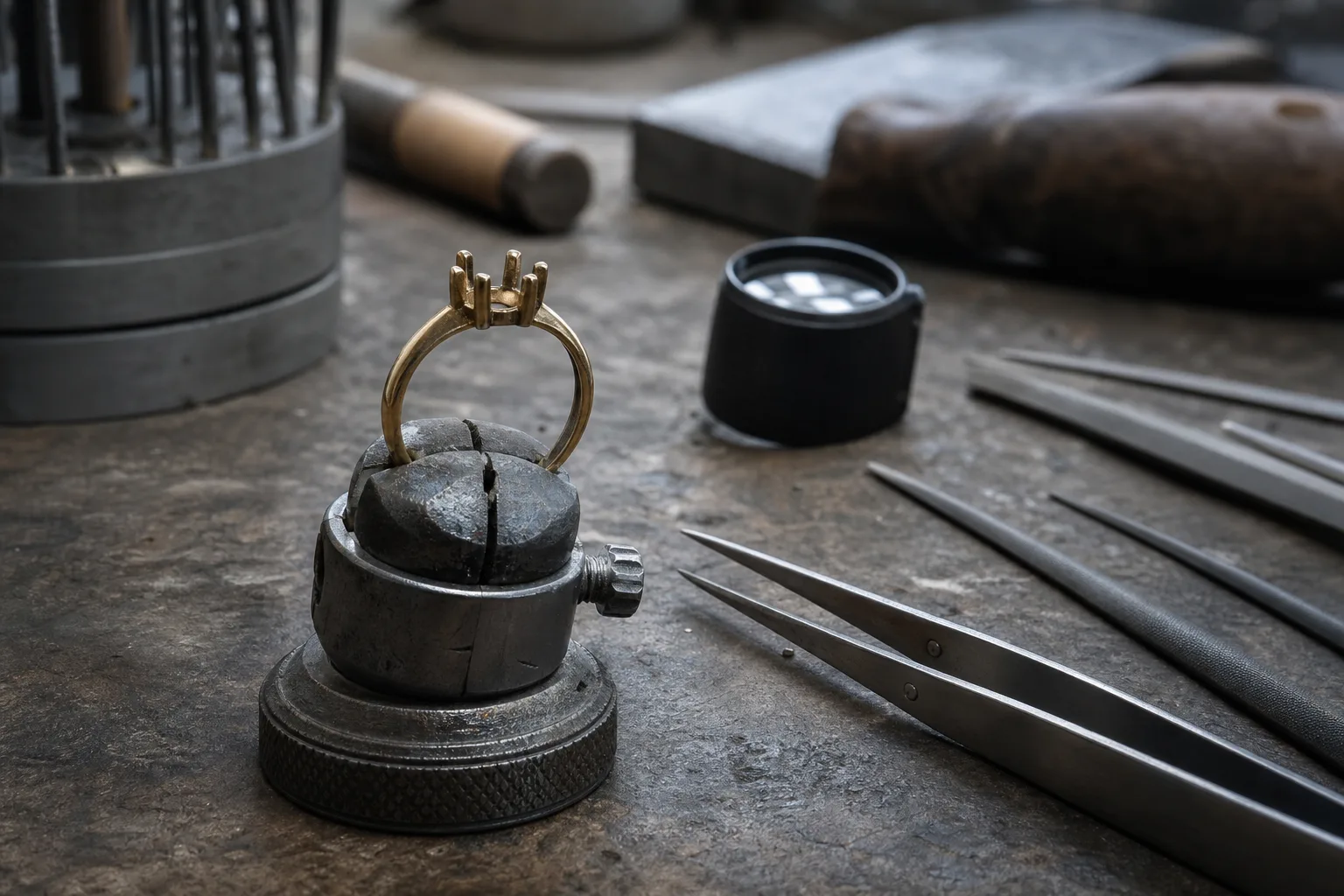
A two-tone engagement ring from the mid-1990s comes across the counter with three separate problems, and only one of them is the one the owner mentions. She wants it sized up two, because it has not gone past her knuckle in four years. The bench jeweler, looking through a loupe, sees that two prongs on the center stone have worn to about half their original thickness, that one bead in the pavé row is gone along with the small diamond it held, and that the white gold has yellowed under thinning rhodium. Three jobs. One ring. Three different pricing logics, and only one of them is negotiable.
What the bench is actually charging for
Jewelry repair prices are built from three inputs, and knowing which one is moving explains almost every quote you will ever be handed. There is bench time, billed at whatever the shop's hourly rate is, which varies with the jeweler's skill and the local cost of running a shop with a safe, insurance and a torch. There is metal, priced by weight against the daily market, which is why sizing up costs more than sizing down even though the physical work is similar. And there is risk, the unstated premium a shop adds when a stone is heat sensitive, a setting is antique, or a repair could go wrong in a way the shop has to make good.
That third input is the one customers rarely see itemized and the one that has shifted most. A jeweler who has to unset an emerald, complete a torch repair, and reset it is pricing an hour of skilled work plus the possibility of destroying a stone that cannot be replaced. The same job with a laser welder is a different proposition entirely, because the heat stays within a fraction of a millimeter of the weld and the stone never leaves the setting. Same repair on the invoice. Different work behind it.
Sizing up, sizing down, and the point where the shank should be replaced
Sizing down is subtraction: the jeweler cuts the shank, removes a segment, closes the gap, welds, files and polishes. The removed gold usually goes into the shop's scrap, and a good shop will credit it or at least tell you it exists. Sizing up is addition, and the added material is bought at market. Gold has been expensive enough for long enough that this line item now visibly drives quotes on heavy shanks, wide bands and anything platinum, where the density means even a small insert carries real weight. On a thin, delicate band the metal cost is close to noise and the labor dominates.
There is a threshold most owners are never told about. When a shank has worn thin at the bottom, from years of contact with keys, steering wheels and countertops, adding a sizing bar or stretching the ring is repairing the strongest part of a compromised structure. The correct call is a new half shank, which costs more up front and lasts another two decades. A shop that recommends the shank when you asked only about size is not upselling you. It is refusing to warranty a weld into metal that will crack somewhere else within a year.
What changed, and why the old advice expired
Laser welding moved from a specialty tool to standard equipment in serious repair shops over the past fifteen years, and pulse arc welders brought a cheaper version of the same capability to smaller benches. The practical result is that a long list of repairs once described as impossible or ruinously expensive is now routine. Retipping prongs on a ring set with opal, tanzanite or an older treated emerald, repairing a cracked bezel next to a stone, sizing a ring with pearls or enamel still in place: these were torch jobs, meaning full disassembly, or they were declined. The advice a customer got in 2005 about heat sensitive stones was accurate then and is often wrong now.
The second change is where the work physically happens. Plenty of retail counters never had a bench behind them and shipped everything to a trade shop, which is fine and always was, but it means the person quoting you is relaying a price rather than setting one. In a place like the Virgin Islands, where the retail concentration is built around visiting buyers, the distinction matters more than usual, and among jewelry stores in st thomas the useful question is whether a repair stays on the island or crosses water twice. Salt air and humidity accelerate the wear that brings rings in, so local repair capacity is not a small consideration.
Who actually holds the decision
The customer is being addressed, but she is frequently not the one deciding. If the ring is under a manufacturer's warranty or a store's lifetime service plan, the terms usually void coverage the moment an outside bench touches it, which means the plan holder decides where the work goes and how long it takes. If the piece is scheduled on a homeowners policy or a standalone jewelry floater, the insurer's appraisal requirement and its preferred replacement channel decide whether a damaged piece is repaired or replaced outright. And on any repair involving a stone the shop cannot match, the setter decides what is achievable long before the counter quotes a number.
The Federal Trade Commission oversees how precious metal content and gemstone treatments are described in the trade, which is the backstop for what a repair invoice can honestly call the material going into your ring. Ask for the karat and the weight of any added gold in writing. Ask whether a replacement melee diamond is natural or lab grown, because both are now routine in repair stock and the price difference is real. A shop that answers those two questions without hesitation is a shop that has already decided to tell you the truth about the shank.
The ring went out with a new half shank, four retipped prongs, one replaced melee stone and fresh rhodium, sized to fit. The sizing, the thing she came in for, was the smallest line on the invoice.