Health
Chest Pain, Two Nights, and One Status Line. What Decides the Rest of the Bill
A hospital statement is read backwards by most patients. The people who read them for a living start with the status line, and so should you.
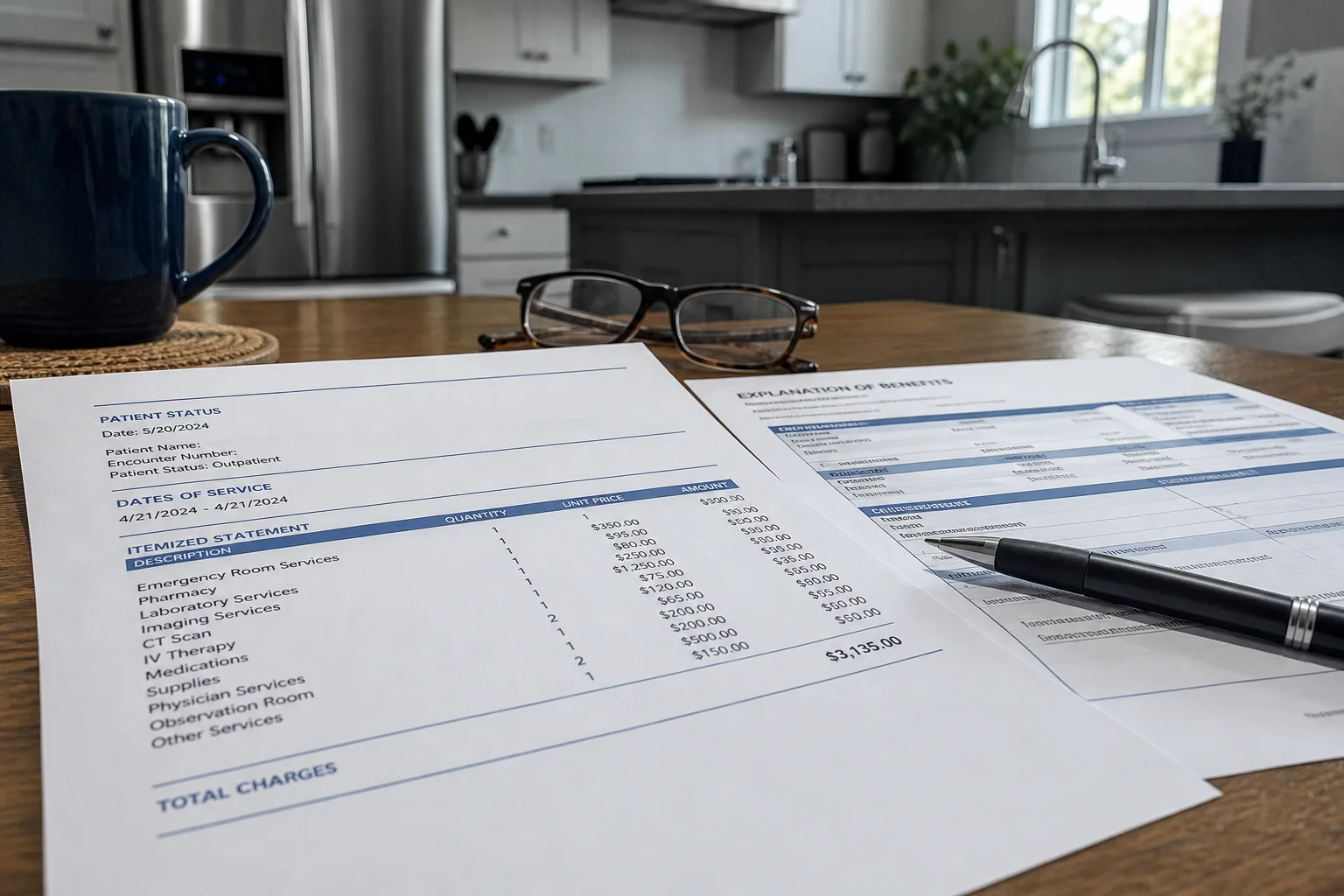
A sixty-one-year-old woman arrives at an emergency department on a Friday evening with chest pressure and shortness of breath. She is moved to a monitored bed, has troponins drawn three times overnight, gets a stress test Saturday morning, and goes home that afternoon. Two nights in a hospital bed, by her count. The statement that reaches her six weeks later runs to several pages and a couple of hundred lines, and she begins where almost everyone begins, at the pharmacy charges, because those are the ones that look absurd. The line that governs the entire document is on page one, and it says observation.
The one line that reorganizes the other two hundred
Patient status is not a description of where you slept. It is a billing category, set by a physician's order, and it determines which part of the insurance contract applies to everything that follows. Under observation, services are billed as outpatient, which for Medicare beneficiaries means Part B rather than Part A, separate cost sharing on individual services, self-administered drugs that may not be covered at all, and no qualifying stay for a subsequent skilled nursing facility admission. Under inpatient, the same clinical care collapses into a different payment structure entirely. Anyone who reads these documents repeatedly checks status before reading anything else, because a disputed charge inside the wrong status is a wasted afternoon.
What this bill looked like a decade ago
Ten years ago, the same patient would have received a summary statement with a balance and a handful of department totals: pharmacy, laboratory, radiology, room and board. Getting the itemized version meant a phone call, a wait, and sometimes a mailed packet that arrived after the due date on the summary. The explanation of benefits came separately, on a different schedule, in a format that did not line up with the hospital's. Comparing the two was a manual exercise in matching dates of service. The status question was buried, if it appeared at all, and most patients learned they had been under observation only when a nursing facility later declined to bill Medicare.
The current document is a different object. Hospitals now publish standard charges in machine-readable form and in a consumer display of common shoppable services, and the Centers for Medicare and Medicaid Services oversees both that requirement and the notice hospitals must give patients placed under observation for more than twenty-four hours. Itemized statements are generally available on request and often by default through a portal. Uninsured and self-pay patients are entitled to a good faith estimate in advance of scheduled care. None of this makes the bill shorter. It makes the bill checkable, which is a different and more useful thing.
Who actually held the decision, and when
The patient reading the statement is being addressed as though she chose something. She did not. The admitting emergency physician wrote an order under time pressure, a utilization review nurse screened that order against clinical criteria within a day, and if the case was ambiguous it went to a physician advisor, a doctor employed or contracted by the hospital to review status decisions against medical necessity standards and payer rules. That review happens while the patient is still in the building, usually without her knowledge, and it is the last cheap moment in the whole sequence. Afterward, changing status means a formal process, condition code 44 or a self-denial and rebill, and both have narrow windows.
This matters for how you read the bill, because it tells you which questions have an audience. A charge for a drug you never received is a hospital question, answerable by the billing office against the medication administration record. A status that looks wrong for two nights of cardiac monitoring is a utilization review question, and the people who answer it are clinicians, not clerks. Patients who get movement on status almost always got it by asking the case management department to reopen the determination, with the physician's documentation in hand, rather than by arguing about the pharmacy line.
The order a practiced reader uses
Start with the explanation of benefits from the insurer, not the hospital statement, because the EOB shows the allowed amount, the contractual adjustment, and the portion assigned to you. A hospital statement issued before the claim has processed is a placeholder, and paying it is how people overpay. Then pull the itemized bill and check status, dates of service, and units. Units are where errors cluster: a drug billed in milligrams rather than vials, an hour of observation counted twice at a shift change, a recovery room charge on a day the patient was already on a floor. Then, and only then, look at individual codes.
The codes themselves are more legible than they used to be. Revenue codes group charges by department, HCPCS and CPT codes identify the specific service, and modifiers explain why something was done twice or on both sides. A reader who has done this many times does not memorize them. She looks up the handful that drive the largest dollars, confirms they match the discharge summary and the medication record, and leaves the rest alone. The small lines are rarely where the money is, and the hours spent on them are hours not spent on the status determination that set the entire structure.
The useful shift over the decade is not that bills got friendlier. It is that the information needed to check one is now obtainable without a fight, and that the decision driving the total has a name, a timestamp, and a department responsible for it. Ask who wrote the status order, and when it was reviewed.