Health
Cleared Out the Filing Cabinet? Which Records Have a Clock and Which Never Expire
A free shred day took the one box that mattered. A look at who gives households retention advice, who pays them for it, and which records have no expiration at all.
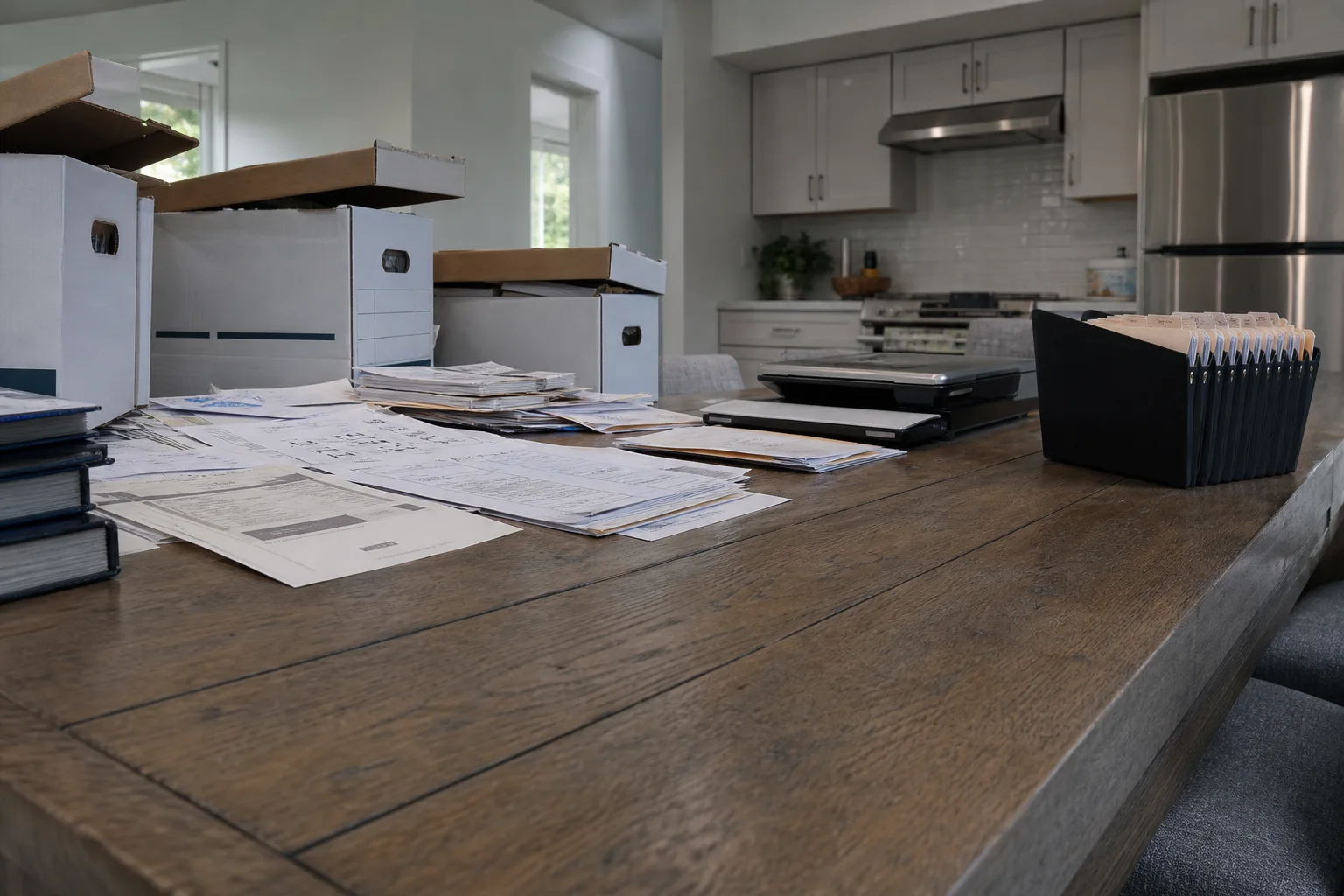
A couple in an inner-ring suburb spent a Saturday morning at a free shredding event in a bank branch parking lot, four banker's boxes in the trunk, having spent the previous evening going through them against a flyer that said most household paperwork can go after seven years. They kept the current mortgage statements and the last two tax returns. Into the truck went a decade of contractor invoices, including the kitchen they gutted and the bathroom they added. Eleven years later they sold the house, and the preparer asked for the cost basis records that would have reduced the gain.
The shred truck was free, and somebody was still being paid
The bank sponsored the event as community outreach, which is a marketing line item. The shredding company was paid by the truck, or by the pound, on a contract signed by the bank's regional office. Nobody in that parking lot was paid to ask what was in the boxes, and nobody had any financial exposure if the wrong thing went in. The seven-year number on the flyer was a borrowed tax rule of thumb applied to every category of paper a household owns, which is how a remodel invoice ends up treated like a utility bill. That mismatch is the whole problem, and it is fixable in an afternoon.
Four people will give you a retention number, and each one is paid differently
The tax preparer is paid per return, sometimes per hour during an examination, and the number they give you is shaped by the window in which a return can be questioned. Read the engagement letter and you will usually find a line saying the firm is not your record repository and that supporting documents are your responsibility. That is not evasion. It is an accurate statement of what you bought. The IRS is responsible for setting the periods of limitation that govern assessment, and those periods run short in ordinary circumstances and longer in specific ones, which is why a preparer's answer is a floor rather than a plan.
The insurance agent is paid a commission by the carrier, renewing annually, and their retention advice points at the moment of a claim: the policy declarations, the endorsements, the receipts and photographs that establish what you owned and what it was worth. The closing attorney and the title company are paid once, at the table, and their file closes. The estate attorney is paid hourly, often years later, and cares about a narrow set of documents that prove title, identity and intent. Line those four answers up and they do not conflict. They are describing different clocks, and only one of the four is tax.
Three clocks, and the one with no clock at all
The first category is statutory. Returns, the W-2s and 1099s behind them, charitable acknowledgment letters, records of retirement contributions that were already reported: these have a defined window after which the risk of needing them drops sharply. The second category is governed by a counterparty rather than a statute. A roof warranty runs for a term written by the manufacturer and usually requires the original invoice and proof of who installed it. A payoff letter matters until the lien release is recorded. A disputed medical bill matters until the explanation of benefits and the provider's ledger agree. Each of those clocks ends when the other party's obligation ends.
The third category has no clock, and it is the one the shred truck ate. Cost basis records for a home run until the home is sold and the gain is computed, which can be forty years. Improvement invoices, the permit file, the survey, the deed, the title policy and any easement agreements all sit here. So do birth and marriage certificates, military discharge papers, naturalization documents, divorce decrees with property and support terms, beneficiary designations on retirement accounts, and records of nondeductible contributions to an IRA that establish the portion already taxed. These are small in volume. A single accordion folder usually holds the whole category for a household of four.
Replaceable, retrievable, and gone
Before keeping anything, it helps to sort by who else holds a copy. Transcripts of filed returns can be obtained from the IRS, and an earnings history is held by the Social Security Administration, so a lost W-2 is an inconvenience rather than a loss. Banks and brokerages keep statements available for a defined period and will produce older ones for a research fee, which is a real cost but a known one. A county recorder holds the deed, the mortgage and the lien release, and will sell you a certified copy. Anything in those hands can be replaced on demand for a modest fee.
Then there is the paper nobody else is holding. The contractor who built the addition may have dissolved the LLC. The specialty window manufacturer may have been acquired twice. Receipts from a cash-and-check era of home improvement exist in exactly one place. Photographs of the rooms before the remodel, the serial numbers on appliances, the itemized inventory you made after a burglary: no counterparty is custodian of any of it. That distinction does more sorting work than any retention schedule, because the question stops being how old is this and becomes who else would have it if I did not.
Where the records live, and the fee that renews
A labeled box in a closet costs nothing and survives everything except water and fire, both of which are precisely the events that generate the claim where you need it. A scanner and two drives, one kept somewhere else, is a one-time purchase and a weekend of work, after which the marginal cost of keeping a document for thirty more years is effectively zero. A safe deposit box carries an annual fee paid to the bank and a practical problem at death, when access depends on who is on the signature card and what the state permits. A cloud subscription is billed monthly, forever, by a vendor whose revenue does not depend on you ever opening the folder.
None of those is wrong, and the sensible household usually runs two. The useful test is to ask what each option costs over the life of the longest clock you are keeping, which for basis records is measured in decades. A recurring fee compounds across that span; a scanner does not. If the cloud copy is the one that matters, the single most valuable five minutes is naming a legacy contact or account recovery person, because a provider will not open an account to a surviving spouse on a phone call. Set that once and the storage question stops needing revisiting.
The couple in the parking lot got most of it back, slowly, through permit records at the building department, a bank's research desk, and one contractor who still had the job file. It took weeks and it worked. The faster version is to pull the no-clock folder first, before any purge, and let everything else be sorted by the person whose deadline it actually is.