Housing
Why the Maintenance List Stalls by March, and What the Version You Keep Actually Costs
A homeowner's forty-seven item annual maintenance calendar collapsed in ten weeks. Working backward from that shows what upkeep really costs and which schedule survives contact with a calendar.
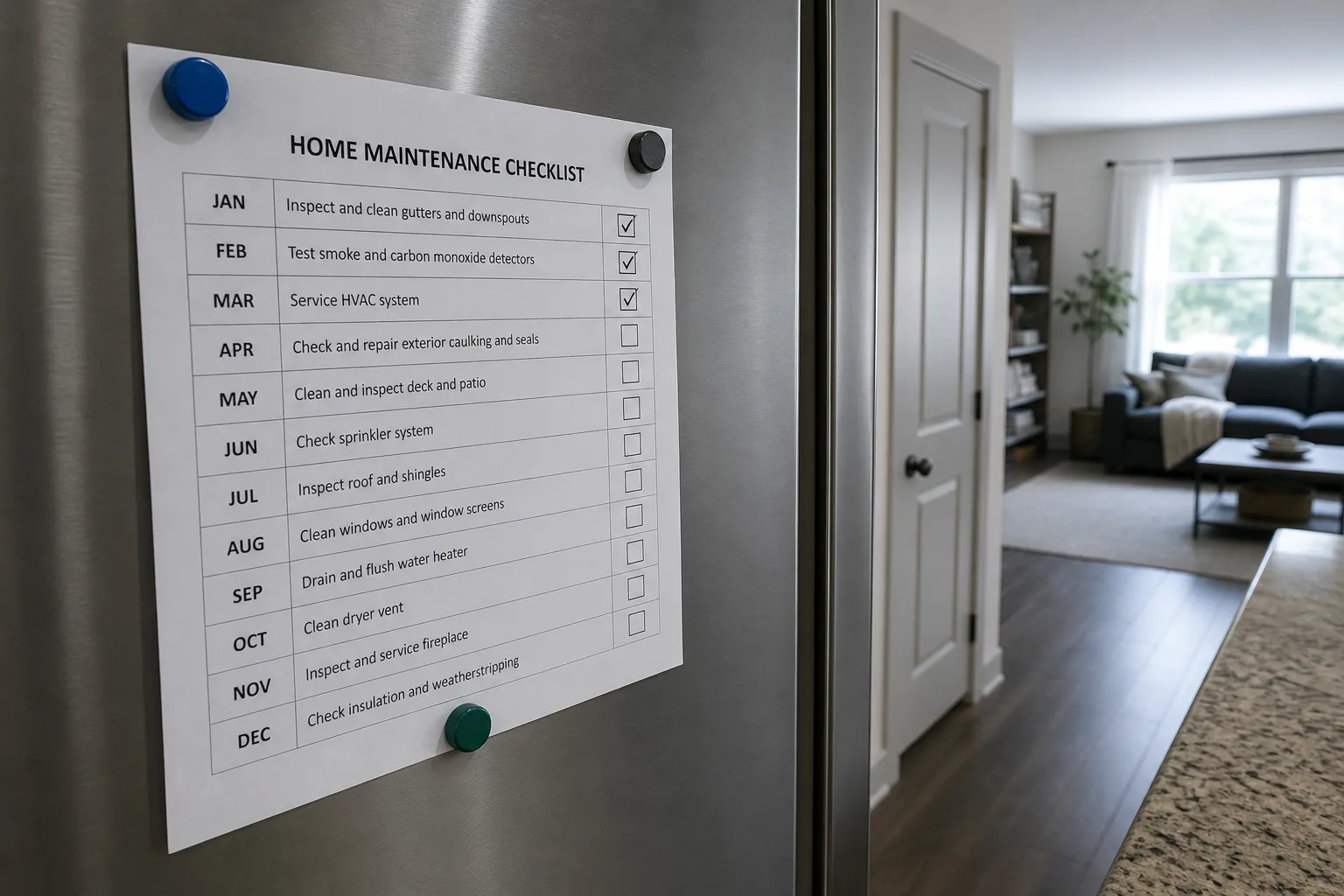
A homeowner in a 1996 two-story bought the house in September and printed a maintenance calendar the same week, forty-seven items spread across twelve months, sourced from a builder's handover packet and padded out with items from a warranty pamphlet. October went well: gutters cleared, furnace filter changed, hose bibs drained, smoke detector batteries swapped. November had six items on it and three got done. By the second week of March the sheet was on the side of the refrigerator with four checkmarks on it, and the household had stopped looking at it. Nothing had failed yet. That came later.
What the sheet asked for, and what it cost to answer
Run the forty-seven items back through what each one actually required and a pattern appears fast. Nine of them needed nothing but ten minutes and a step stool. Eleven needed a tool the house did not own, a shop vacuum with a narrow attachment, a moisture meter, a hex key set, a ladder tall enough to reach a second-story soffit safely. Six needed a licensed trade because they touched gas, refrigerant, or the electrical panel. The rest needed a Saturday with nothing else in it. The calendar treated all forty-seven as equivalent single lines, which is the decision that made the stall likely.
Cost followed the same split. The ten-minute items ran to consumables: filters, batteries, a tube of sealant, maybe sixty to a hundred dollars a year for a house that size. The trade items each carried a visit, and a visit is priced as a visit. Whatever the diagnostic or service fee runs in a given market, it is charged once for showing up and again for showing up a second time in April, which is why the annual cost of a maintenance list depends far less on the work than on how many separate times someone drives to the house.
The trip charge is the line item nobody schedules around
The household in question called an HVAC company in November for the furnace, a plumber in February for a slow drain, and the same HVAC company again in May for the air conditioner, because that is how the calendar had laid it out, one system per season. Three visits, three minimum charges, three afternoons taken off work. A contractor asked afterward would have said the furnace and the condenser could have been handled in one spring appointment with a slightly longer labor block, and that the drain was a fifteen-minute add-on to either. The customer never asked, because the printed calendar had already told them when each item belonged.
That is the first real cost driver, and it is the one homeowners control most directly. Bundling work by who has to come rather than by which month the pamphlet assigned it collapses three trips into one. The second driver is access: a technician who has to move stored boxes to reach a water heater, or set up on a slope to reach a second-floor unit, is billing time that has nothing to do with the maintenance itself. Clearing three feet around every serviceable piece of equipment before the truck arrives is unpaid work that reduces a paid hour.
What the failure actually cost, traced backward
In August of the following year the condenser stopped cooling on a Friday evening. The coil was packed with cottonwood and lawn clippings, the capacitor had gone, and the call went out after hours at the after-hours rate. The repair itself was modest. The premium for a Friday night in August, the second trip when the part was not on the truck, and the two days of a house at eighty-six degrees were not. Reconstruct the chain and it does not start at the capacitor. It starts at a March calendar that asked for a coil rinse in a month when nobody was thinking about air conditioning.
The Department of Energy is the federal body responsible for the efficiency standards that govern residential heating and cooling equipment, and the operating assumption behind those ratings is a unit with clear airflow. A blocked coil does not announce itself. It shows up as a longer run time and a higher bill for a season or two before it shows up as a failure, which is exactly why it survives on a printed list unread.
The schedule that survives is shorter and tied to something else
The version this household now keeps has eleven items, not forty-seven. Four are tied to events already in the calendar for other reasons: filters change when the quarterly bulk order arrives, detectors get tested when the clocks change. Five are bundled into two contractor visits booked twelve months apart at the same time each year, with the appointments made while the technician is still in the driveway. Two are seasonal walk-arounds with a phone camera, one before the first freeze and one after the last. The annual outlay is predictable, the visits are known months in advance, and the items get done because none of them requires deciding to do them.
The forty-seven item list was not wrong about the work. It was wrong about the customer, who was never going to open a refrigerator door in March and find the line about a condenser coil. A schedule is a document about behavior before it is a document about a building, and the one worth paying for is the one that still has checkmarks on it in August.