Government
A Notice Card, Nine Days and Item Seven. Where an Objection Actually Lands
A first-time objector arrives at a planning hearing to find the decision mostly made. Working backwards shows where the file was open and how to reach it next time.
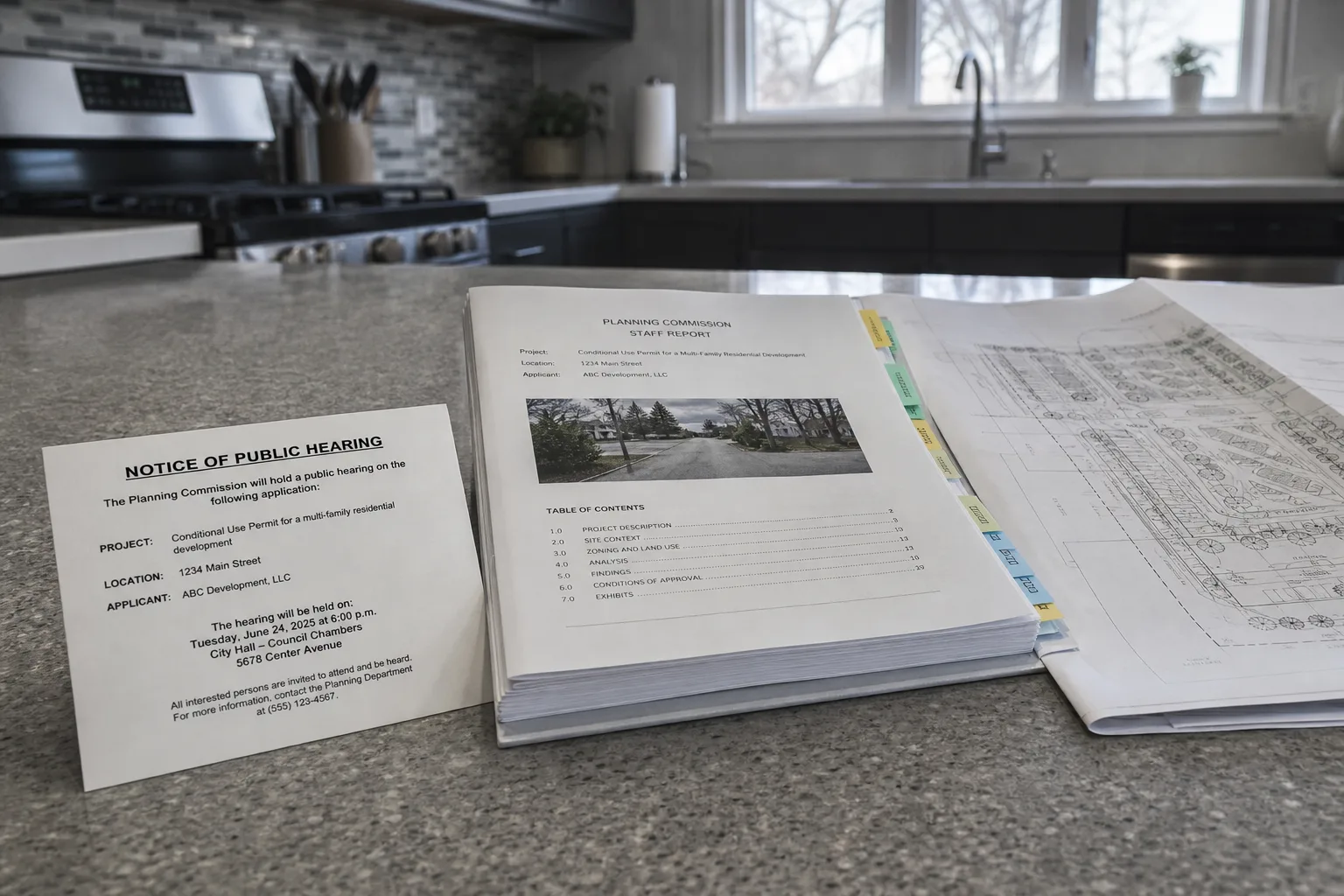
The card arrives on a Tuesday, printed on stock the color of a dentist's reminder, and it says a public hearing on a conditional use permit for a self-storage facility will be held in nine days at seven in the evening. The recipient has never been to a planning commission meeting, has no idea what a conditional use permit is, and spends most of those nine days doing what seems reasonable: talking to neighbors, drafting a letter about traffic on a street with no sidewalk, and rehearsing three minutes of remarks. At the hearing the item is approved in roughly eleven minutes. Nothing improper happened. The decision had simply been assembled somewhere else.
The clock was set by people who were not thinking about you
Notice periods in most American jurisdictions are statutory minimums, written into state planning enabling acts decades ago and then copied into local codes with small variations. They were designed to solve a different problem than the one a first-time objector has. The problem they solved was applicants being ambushed, and owners of adjacent property learning about a rezoning after the foundation was poured. A fixed, short, predictable window gave everyone a date certain. What it did not do, because nobody drafting it imagined the need, was give a resident time to learn an unfamiliar administrative vocabulary from scratch. The nine days are the end of a process, not the start of one.
The file was open for months and it was open to anyone
Work backwards from the eleven minutes and you find the application was submitted in the spring, routed to engineering, fire, and the county health department for comment, revised twice after staff asked for a wider drive aisle and a deeper landscape buffer, and then written up in a staff report that recommended approval subject to fourteen conditions. Every one of those steps generated a document, and in almost every jurisdiction those documents are public from the day they are filed. The counter clerk will hand over the file. Some cities post the whole packet online the Friday before the meeting. The hearing is where the record is closed, not where it is made, and the people who get conditions changed are the ones who showed up while it was still being written.
Why so much is decided before anyone speaks
The consent agenda, the staff recommendation, and the standard conditions list all grew out of volume. Planning commissions are usually unpaid residents meeting twice a month, and they cannot originate the technical review of a stormwater plan or a sight-distance calculation, so they rely on staff to do it and to tell them whether the application meets the criteria in the code. That reliance is the whole design. It also explains why a comment about neighborhood character tends to land softly while a comment about an approval criterion lands hard. The commission is not weighing opinion against opinion. It is deciding whether a set of written findings can be made on the evidence in front of it.
What a first objection has to contain to count
Find the code section the application was filed under, which is printed on the notice card and repeated on the first page of the staff report, and read the list of criteria the applicant must satisfy. There are usually between four and eight. Address them by number. If the criterion requires adequate access, say which street, at what hour, with what sight line, and attach a photograph. If the site touches a mapped floodplain, the local overlay almost certainly references the flood mapping that the Federal Emergency Management Agency is responsible for maintaining, and the map panel number belongs in your letter. Submit it in writing before the deadline stated on the notice, then speak to the same points. Written comments enter the record. Spoken ones sometimes do not.
The second window is the one most people miss
Almost every approval carries an appeal period, commonly ten to twenty-one days, during which a party who participated can take the decision to the city council, a board of adjustment, or occasionally a state land use board. Participation is usually the test, which is the practical reason to file something in writing even when you expect to lose at the commission. Appeals are generally confined to the record, meaning new evidence will not be considered and the argument has to rest on what was already submitted. A first-time objector who writes to the criteria in week one has standing and material in week four. One who only spoke about traffic in general terms has neither.
The storage facility was built. The drive aisle sits a few feet further from the property line than the original drawings showed, and there is a row of trees that staff asked for in June, before the card ever went in the mail. That is what influence usually looks like at this scale: conditions, not denials, won by people who found the file while it was still being written.