Health
Who Paid for That Credential? Five Checks to Run Before You Book a Procedure
A license, a manufacturer's certificate and a collaborating physician you never meet are three different things. Here is how to tell which one actually covers you.
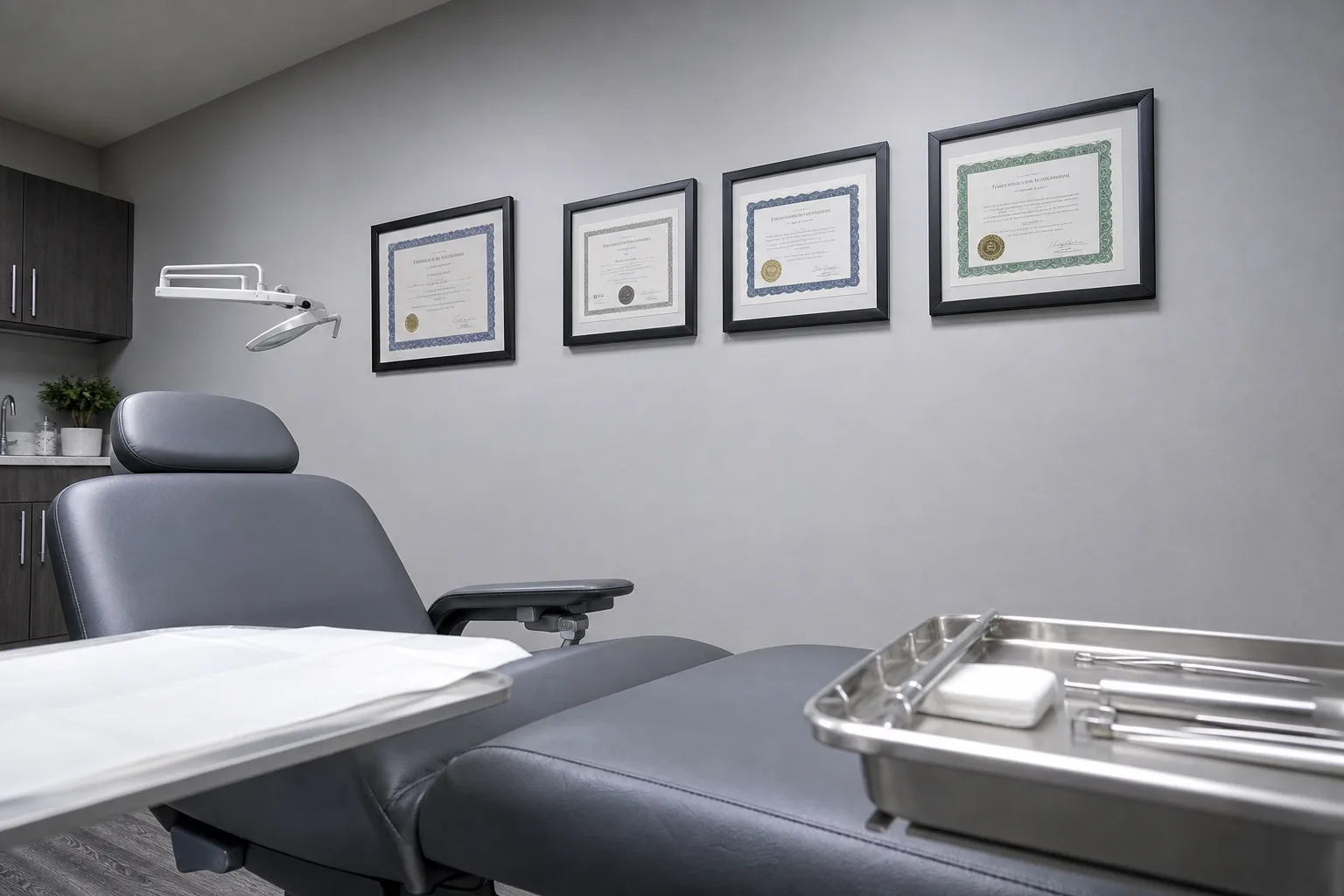
A woman books a consultation at an aesthetics clinic in a suburban strip mall for filler along the jawline, and the intake goes smoothly: a tablet form, a photograph, a quoted price per syringe. Behind the treatment chair hang four framed documents, one of them a state nursing license and three of them certificates naming training courses. The injector is an RN, competent, unhurried, and entirely open about her training. What the patient does not ask, and what almost nobody asks, is who paid for each of those four pieces of paper, and which of them would matter if the filler went into a vessel. Two of the four would.
Start with the state license, then read the board file for what is missing
Every state health licensing board publishes a verification lookup, and the search takes under a minute: name, license number, status, issue date, and in most states a disciplinary history. That record tells you the practitioner is legally permitted to practice a defined scope in that state, which is real and worth confirming, and it tells you nothing about whether they have injected a jawline before. Scope is the useful part. A nursing license, a physician assistant license and a medical license authorize different acts, and the board's own scope-of-practice page, not the clinic's brochure, is where that line is drawn. Print the verification page. It is dated, and dates matter later.
Ask who issued the certification, and who was paid to issue it
Certificates fall into two categories that look identical on a wall. The first is specialty board certification through a recognized certifying body, earned after a residency or an equivalent training pathway, verifiable through the certifying board's own public directory and maintained through periodic recertification. The second is a course completion certificate, often a weekend, sometimes a single day, frequently taught by or underwritten by the company that manufactures the product being injected. Neither is worthless, but the money runs in opposite directions: in the first, the candidate pays the board to be examined, and in the second, the manufacturer effectively pays to have more clinicians using its device. Ask which one you are looking at, by name.
Find the collaborating physician, and find out what the arrangement actually pays for
This is the party in the transaction most people overlook, and in many states the arrangement is the legal foundation for the whole appointment. Where a nurse or a physician assistant performs a medical procedure under delegated authority, a named physician signs a collaborative or supervisory agreement, sets protocols, and in some states must be reachable or on site. That physician is usually paid a monthly fee by the clinic. Ask for the name, then run it through the state medical board lookup yourself, and ask a plain question: if something goes wrong at four in the afternoon, who is called, and how quickly can that person be physically present? A clinic with a good answer gives it immediately.
Ask for the malpractice certificate rather than the reassurance
A certificate of insurance is a one-page document, and any practitioner who carries coverage can produce one. Read three things on it: the named insured, whether the individual practitioner is covered or only the entity, and whether the policy is claims-made or occurrence-based. Claims-made policies cover claims reported while the policy is active, which is why departing clinicians buy tail coverage, and why a clinic that closes can leave a patient with a live injury and a dead policy. Coverage also has exclusions by procedure. A carrier may write a policy that does not extend to a specific device or technique, which means the credential on the wall and the coverage in force can genuinely disagree.
Check the facility's own file, and the payer who already did this work
Clinics maintain credentialing files because their insurers and their contracted health plans require them, and privileging is a separate step from licensing: the facility decides which procedures a given clinician may perform on its premises. Where a practice bills insurance, a health plan's credentialing department has already verified the license, the training, the malpractice coverage and the claims history, and network participation is therefore a quiet second opinion you did not pay for. Cash-only aesthetic practices sit outside that check entirely, which is not a mark against them, only a missing layer you should replace with your own questions. The Federal Trade Commission oversees how professional credentials are advertised to consumers.
The four documents behind that treatment chair resolve into a workable order once you know what each one is: the license defines what may lawfully be done, the collaborative agreement names the physician standing behind it, the certificate of insurance says who pays if it goes wrong, and the course certificates describe training that someone had a commercial reason to provide. Ask for all four by name. Practitioners who have organized their paperwork properly tend to hand it over in about ninety seconds.