Housing
Kept Nine Items Out of Forty and Blamed Yourself? The Trigger Decides, Not Your Discipline
Household maintenance lists fail in a pattern: the tasks that survive belong to someone else's calendar. Here is how to work out who holds each trigger, and how that changed.
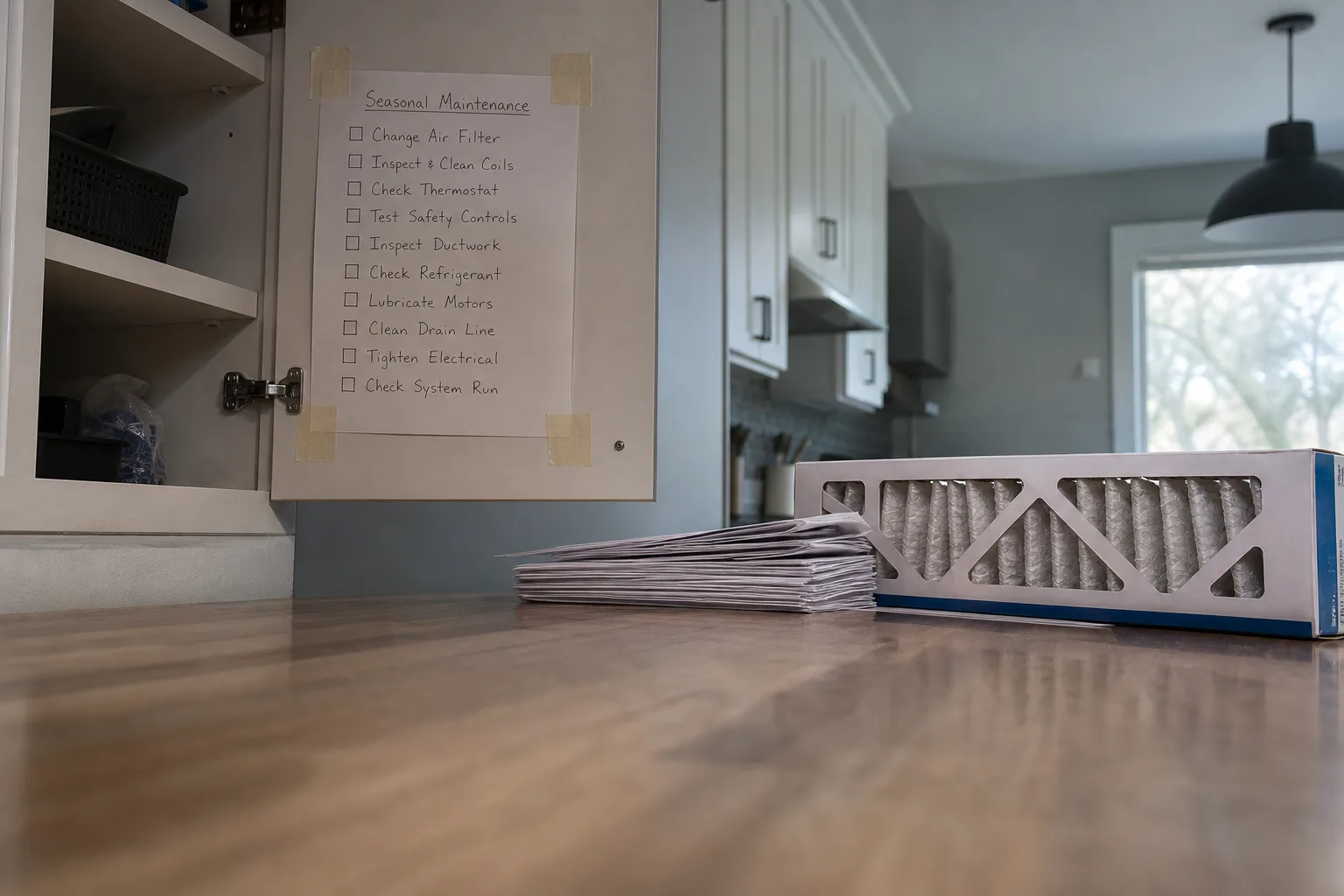
A couple who bought a 1978 split-level put together a maintenance list during their first fall in the house, working off the inspection report, the appliance manuals and a printout from the county extension office. Forty-one line items, sorted by season, taped inside a cabinet door. Twelve months later they went back through it honestly, marking what had actually been done rather than what they intended, and the tally came to nine. The nine were not the easy ones, and they were not the cheap ones. Two involved crawling into an attic in August.
The nine that survived had one thing in common
Every completed item had a trigger outside the household. The furnace tune-up happened because the HVAC company they used for a summer repair enrolled them in a service plan and called in October to book a slot. The fire extinguisher was checked because the same technician looked at it. The water heater was flushed on a plumber's visit for an unrelated leak. Filters were changed because a subscription shipped them. The backflow device was tested because the water utility mailed a notice with a compliance date on it. Nothing on the list survived on willpower alone.
The thirty-two that lapsed were the ones the couple owned outright: gutter checks, dryer vent, grading around the downspouts, caulk at the tub, garage door sensors, the sump pump test. Each was individually trivial. Each required someone in the house to decide, on a given Saturday, that this was the Saturday. That decision never lands, because nothing forces it and nothing notices when it does not happen.
The assumption is discipline. The mechanism is who holds the calendar
Most advice about upkeep is addressed to the homeowner as though the homeowner is the decider, which is why it takes the form of a chart, a printable, an app with checkboxes. The homeowner is the party who pays and the party who suffers the consequences, but on a routine task in a busy month, the homeowner is rarely the party who initiates. The initiating party is a service company with a dispatch schedule, a manufacturer with a warranty condition, a utility with a regulatory deadline, or an insurer with a policy requirement. Design around that and the schedule holds. Design around resolve and it does not.
This reframes the useful question. Instead of asking how often a task should be done, ask who, other than you, has a reason to remember it, and what would it take to put the task inside their existing routine. Sometimes the answer is nobody, and that item goes on a much shorter genuine list. Often the answer is a company already coming to the house twice a year for something else.
What changed: the reminder moved off your calendar and onto someone else's
Over the past several years the number of external triggers available to an ordinary household has grown sharply, and not because anyone set out to help people maintain their homes. Equipment makers added connected controls and app notifications because it lowered their warranty costs and gave them a channel to sell parts. Filter and water treatment companies moved to subscription shipping because recurring revenue is worth more than one-off sales. Insurers began offering discounts tied to leak sensors and automatic shutoff valves because paid water claims are expensive. Utilities pushed rebate and inspection programs onto scheduled digital notices. The effect on the household is the same regardless of the motive.
Energy Star, run jointly by the Environmental Protection Agency and the Department of Energy, is responsible for the efficiency labeling on much of the equipment that now carries these reminder features, and manufacturer filter and service intervals are increasingly tied to it. The practical shift is that a task once written on a wall calendar now arrives as a shipment, a text with a booking link, or a condition attached to a discount, all of which are far harder to ignore than a checkbox you wrote yourself.
How to convert your list into other people's calendars
Take the existing list and sort it three ways. First, tasks a service provider already at the house could absorb: ask the HVAC technician to check the dryer vent run and the water heater anode, ask the pest inspector to note grading and downspout discharge, and get it written on the invoice so there is a record. Second, tasks that can be bought as recurring delivery or annual contract: filters, water treatment, gutter cleaning, septic pumping, chimney sweeping. Third, tasks tied to a document with a date, such as a warranty registration, a permit renewal, or a policy condition.
What is left after those three passes is the real list, and it is short. Usually six or eight items that no company will ever prompt you about: testing the sump pump with a bucket of water, cycling the main shutoff so it does not seize, checking the garage door reversing sensor, running water through unused drains. Attach those to a fixed external date you already observe, the clock change or a birthday, and do them in one pass rather than spreading them across the year.
The couple with the split-level rebuilt their list on this basis in the second year, and the count that mattered was not how many items remained but how many now had a name next to them other than their own. The taped chart came down. What replaced it was a folder of invoices, two standing contracts and one short page for the residue, which is a schedule that survives a bad month.