Digital
Eleven Retailers in One Week. Which of Those New Accounts Actually Needs Your Attention
Holiday checkouts create accounts faster than any other stretch of the year, and the difference between adequate password work and good work is which ones you triage first.
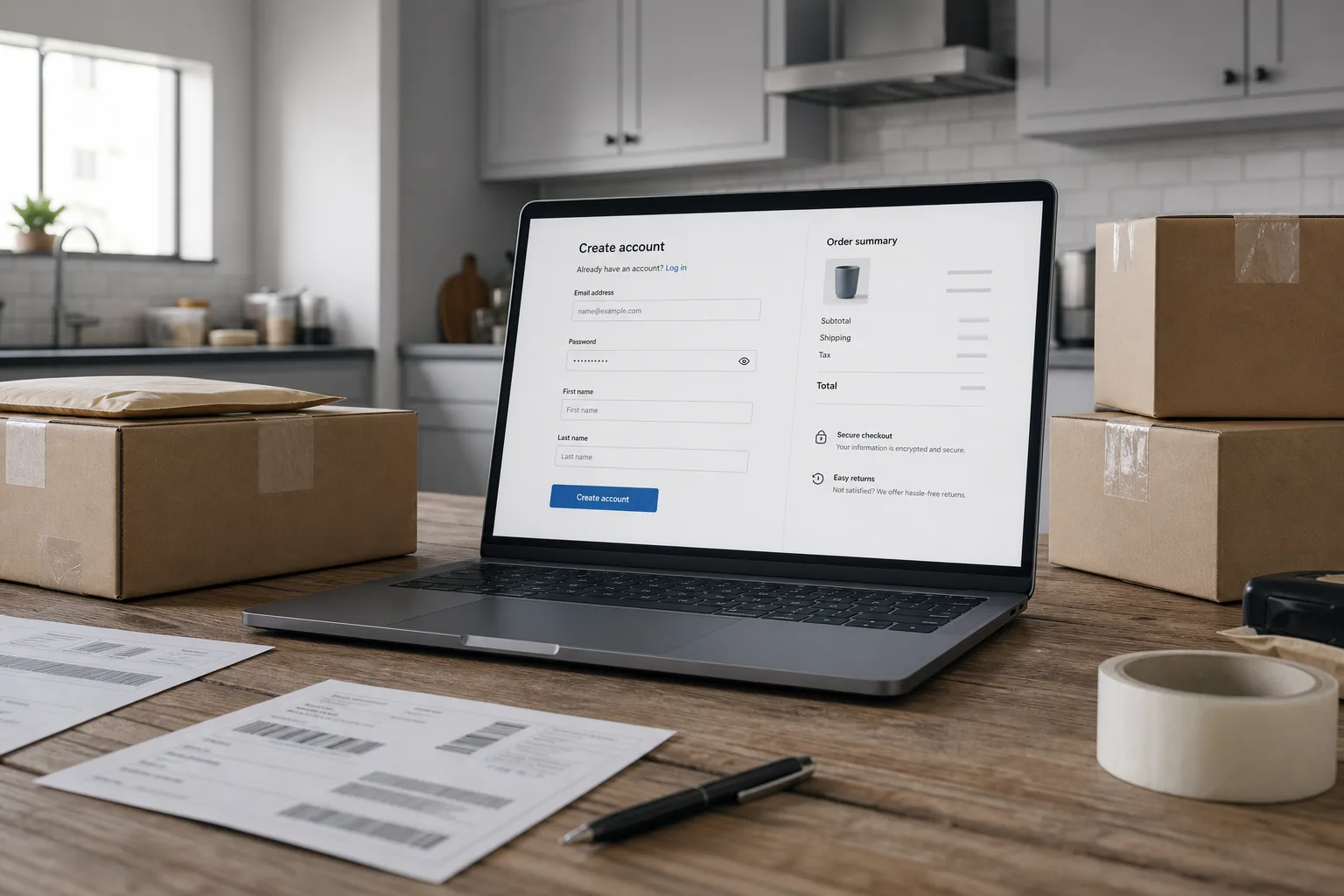
Between the second week of November and the middle of December, a household buying gifts online will typically pass through checkout at eight, ten, a dozen different retailers, and at roughly half of them the order cannot be completed without creating an account first. The form is three fields. Email, password, confirm password. Most people type something close to what they typed at the last store, click through, and never think about that account again until a notification arrives fourteen months later saying the retailer has had an incident. The season does not change what a password should be. It changes how many of them you make in a hurry.
The retailer decides whether an account exists, and you decide once
Guest checkout is a choice the merchant makes, not you. Some stores offer it plainly, some bury it under the account form, and some removed it because an account holder is worth more to their marketing than a one-time buyer. By the time you are looking at the form, the decision has already been narrowed: create an account, or go buy the item somewhere else. That is a real decision, and in late November, with shipping cutoffs approaching, almost nobody makes it in favor of leaving. Knowing that in advance is worth more than any rule about character length, because the only moment you hold the choice is before you start typing.
What follows from that is simple enough to act on. If the store will take a guest order, take it, and decline the offer to save the card. If it will not, you are opening an account, and the question is no longer whether to open it but what that account will be able to do to you later. An account holding your address, your order history and a stored card is a different object from an account holding an email address and nothing else. The retailer sets the floor. You set what sits on top of it.
Unique passwords are the adequate version, and most people stop there
A barely adequate job, by the standard that now applies, means every account has a long password that appears nowhere else, stored somewhere you can actually retrieve it. That is not nothing. It is the single change that stops one breached retailer from becoming a breached bank, and the National Institute of Standards and Technology, which is responsible for the federal digital identity guidance that most corporate password rules eventually descend from, long ago moved the emphasis toward length and uniqueness and away from the forced complexity and routine expiry many of us were trained on.
The good version adds a second thing, and it is the part the holiday rush exposes. Every account you own has a reset path, and that path ends somewhere: usually your email inbox, sometimes a phone number, occasionally both. A unique password on a shoe store is worthless if the attacker can simply request a reset and read the message. So the work is not evenly distributed across your accounts. Your primary email, your phone carrier account and your password manager are the three that everything else is hanging from, and those three deserve a second factor that is not a text message.
What this looks like in an ordinary week, not an audit weekend
Nobody sets aside a Saturday for this, and the people who recommend it have not watched anyone try. The version that holds up is smaller and runs in the gaps. When your password manager flags a reused credential at the moment you log in, you change it then, while you are already sitting in the account settings, which takes under two minutes. When a site offers an authenticator app or a passkey during login, you accept it then rather than filing it away. The week-to-week reality of good password work is that it is almost entirely opportunistic, handled at the exact moment a site has already put you on the page where the setting lives.
The one deliberate habit worth adding is a short pass through the new accounts in early January, when the shipping is done and the inbox still has every order confirmation in it. Search the mail for confirmations, and you have an accurate list of what you opened and when, better than memory and better than guessing. For each one, two questions: is the card stored there, and is the password reused. Most will need nothing. Two or three will need ninety seconds. That is the whole job.
When the site's rules are bad, your choice moves somewhere else
You will still meet sites that cap passwords at sixteen characters, forbid symbols, force a change every ninety days, or offer a second factor only by text message. None of that is yours to fix, and arguing with the support line will not move it. What you retain is the decision about what that account is permitted to hold. A utility portal with weak rules and no stored payment method is an inconvenience if it falls. The same portal with autopay attached to a checking account is something else, and the fix is to pay it from the bank's side rather than the vendor's, which quietly shifts the security question onto an institution that is regulated and funded to answer it.
That reframing is the real difference between adequate and good. Adequate treats every account as a password problem and tries to solve all of them at the same strength. Good sorts accounts by what they can reach, protects the handful that reach everything, and moves the valuable things off platforms that have shown you, through their own login screen, exactly how much they have invested in the question.
Breach notices from holiday retailers tend to land months after the season, long enough that the account name in the letter will not be familiar. The households that read those letters calmly are not the ones with perfect discipline. They are the ones who decided, at the checkout screen in November, which accounts were allowed to matter.