Education
In-State Tuition Denied in September? The Residency Clock That Started Before You Applied
A transfer student lost in-state tuition to a deadline the college relayed but never owned, and the reconstruction shows what a good enrollment office does differently.
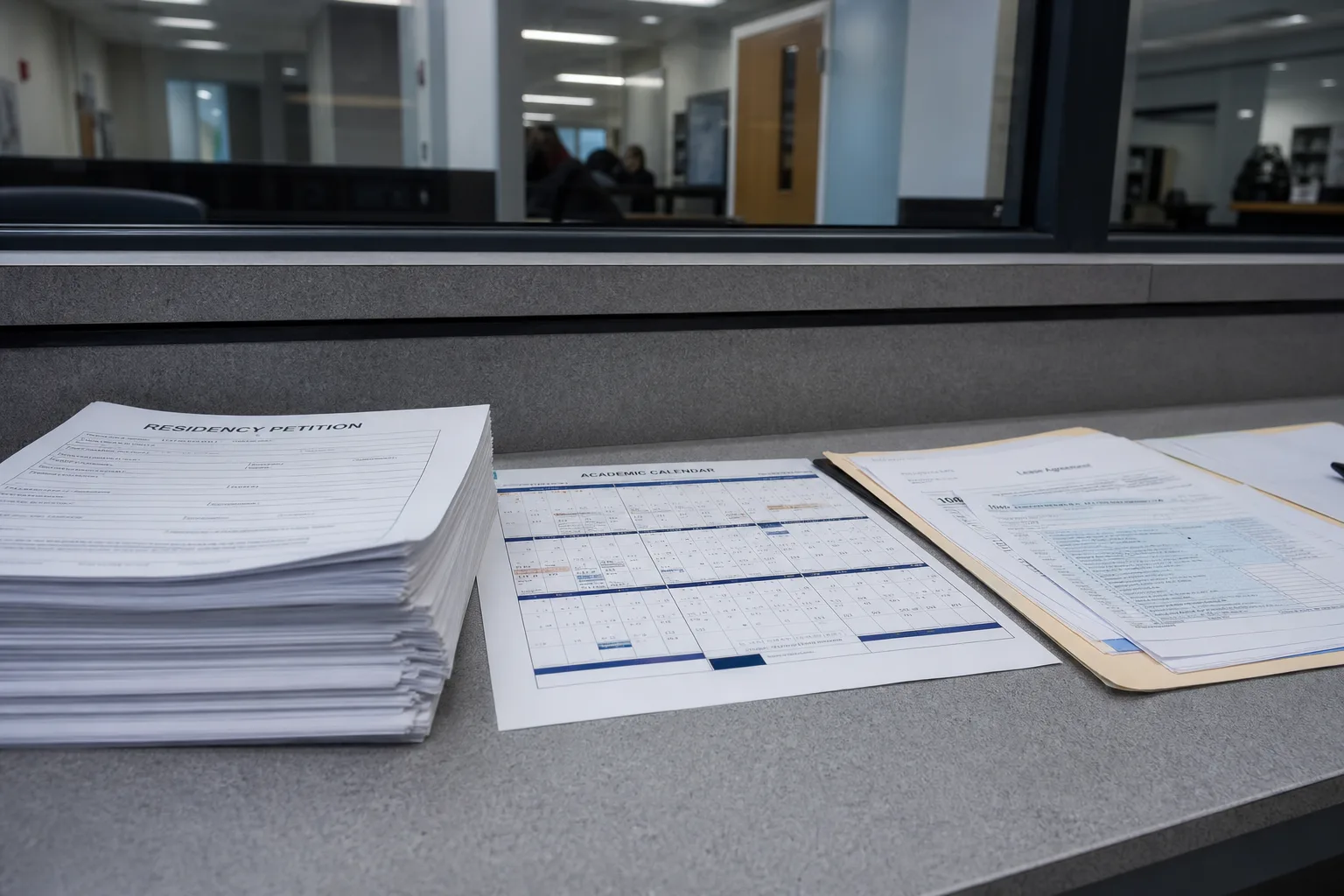
The bill that landed in early September was roughly three times what the student had budgeted, and nothing on it was wrong. She had moved into the state the previous August, worked full time through the winter, filed a state income tax return in the spring, registered a car, and enrolled at the public university as a transfer for the fall. Every fact pointed toward residency. What she had not done was file the residency petition, with its documentary attachments, by the date the university had set: the first day of instruction for the term in which she wanted the rate to apply. She filed on day nine, during the add/drop window, because that was the date she had in her head as the term's real boundary.
The petition was accepted for the following spring. The fall stood as billed. Working backwards from that outcome, the decision that made it likely was not the late filing. It was a moment in April when she asked an admissions counselor whether she would qualify for in-state tuition, got an accurate answer about the twelve-month domicile requirement, and never asked the second question, which was when the paperwork proving it had to be in someone's hands. The counselor answered what was asked. That is the whole distance between an office doing an adequate job and one doing a good one.
The deadlines a school sets, and the ones it only passes along
An institution controls a short list of dates: application, deposit, registration, add/drop, withdrawal, payment. Those appear in the academic calendar, get published early, and rarely move. Around them sits a longer list the school does not control and often does not date precisely on its own materials. Residency classification is usually governed by state statute or a system-wide regental policy, not by the campus. State grant priority filing dates are set by a state agency. Immunization compliance runs off the state health department's schedule. Clinical placement in a health program follows the partner hospital's onboarding calendar, which may close months before the semester.
The relayed deadlines are the ones that cost money, because they are the ones nobody on campus owns. When a student misses add/drop, an advisor hears about it and can sometimes fix it. When a student misses a state grant priority date, the first signal is an award letter in July that is smaller than expected, by which point the funds for the cycle are frequently committed. The U.S. Department of Education oversees the federal student aid programs that sit underneath all of this, and the federal application is the piece most families track. The state layer on top of it is where the variation lives.
Why the same student would have been fine two states over
Residency rules are written state by state, and they differ in three ways that matter to a filing calendar. The durational requirement varies, twelve months being common but not universal. The evidence list varies, with some states weighting a driver's license and voter registration heavily and others looking primarily at employment and tax filings. Most importantly, the filing deadline varies: some systems accept petitions through the census date, some through the end of add/drop, and some, like the one in this case, close on the first day of class with no appeal on timeliness alone. A student who does everything else identically can land on either side of a five-figure difference depending on which line she crossed.
The same pattern repeats below the state level. State grant programs run on their own priority dates, and a handful operate first-come until the appropriation is exhausted, which turns a soft priority date into a hard one in practice. Community college districts often set their own registration and payment-cancellation windows, so a student holding seats at two institutions can be dropped from one for nonpayment while the other is still collecting. Kindergarten age cutoffs and open enrollment lotteries are district decisions, which is why two towns sharing a border can run windows a month apart.
What separates a good enrollment office from a barely adequate one
A barely adequate office publishes its own calendar accurately and answers the questions it is asked. Nothing it does is wrong. A good office does three additional things, and each one is visible from the outside if you know to look for it. It maps the deadlines it does not control and attaches a specific date to each for the specific term you are entering, rather than describing them in the abstract. It tells you, unprompted, which of those dates are irreversible and which have an appeal path. And it names the office or agency that actually holds each one, so that when the answer matters you are talking to the person who can give it rather than someone reading the same web page you are.
The fourth marker is channel. Good offices send critical relayed deadlines through more than one channel and do not assume a student is reading an institutional email account she was issued three weeks earlier. In the case above, the residency filing deadline existed in writing, in a policy document, correctly. It had simply never been placed in front of the student as a dated action item alongside her orientation reminders. When an office moves those items into the same stream as the ones it owns, the failure rate drops without anyone becoming better organized.
Building the calendar before anyone hands you one
Ask, in writing, for every deadline that applies to your enrollment and not just the ones the school administers, and ask for each as a date rather than a description. Then ask which of those close permanently and which allow a late petition. Residency, state grant priority filing, program cohort application, immunization compliance, and any external clinical or licensure onboarding are the five that most often sit outside the academic calendar. For anything governed by state rule, go once to the state agency's own page and confirm the date there, because campus materials are sometimes a cycle behind.
Where a deadline is documentary rather than procedural, work backwards from it. A residency petition that closes on the first day of class needs its evidence assembled weeks earlier, and a document like a prior-year state tax return or a dated lease can take time to retrieve. The student in this case had every document she needed by June. She lost the year's rate to nine days, and to a question she had no reason to know she should ask.
She filed for spring, was reclassified without difficulty, and paid the resident rate for the remaining three years of her program. The evidence she had built over that first year was exactly what the statute wanted. The lesson she took forward, and passed on to a younger sibling entering a different state's system, was to treat every deadline as belonging to whoever wrote the rule, and to find that person first.