Housing
Fans Out on Day Three? The Five Readings and Two Forms That Decide When Drying Is Done
A veteran restorer's account of the meters, logs and signatures that separate a dried structure from a dry-looking one, and who actually holds the decision.
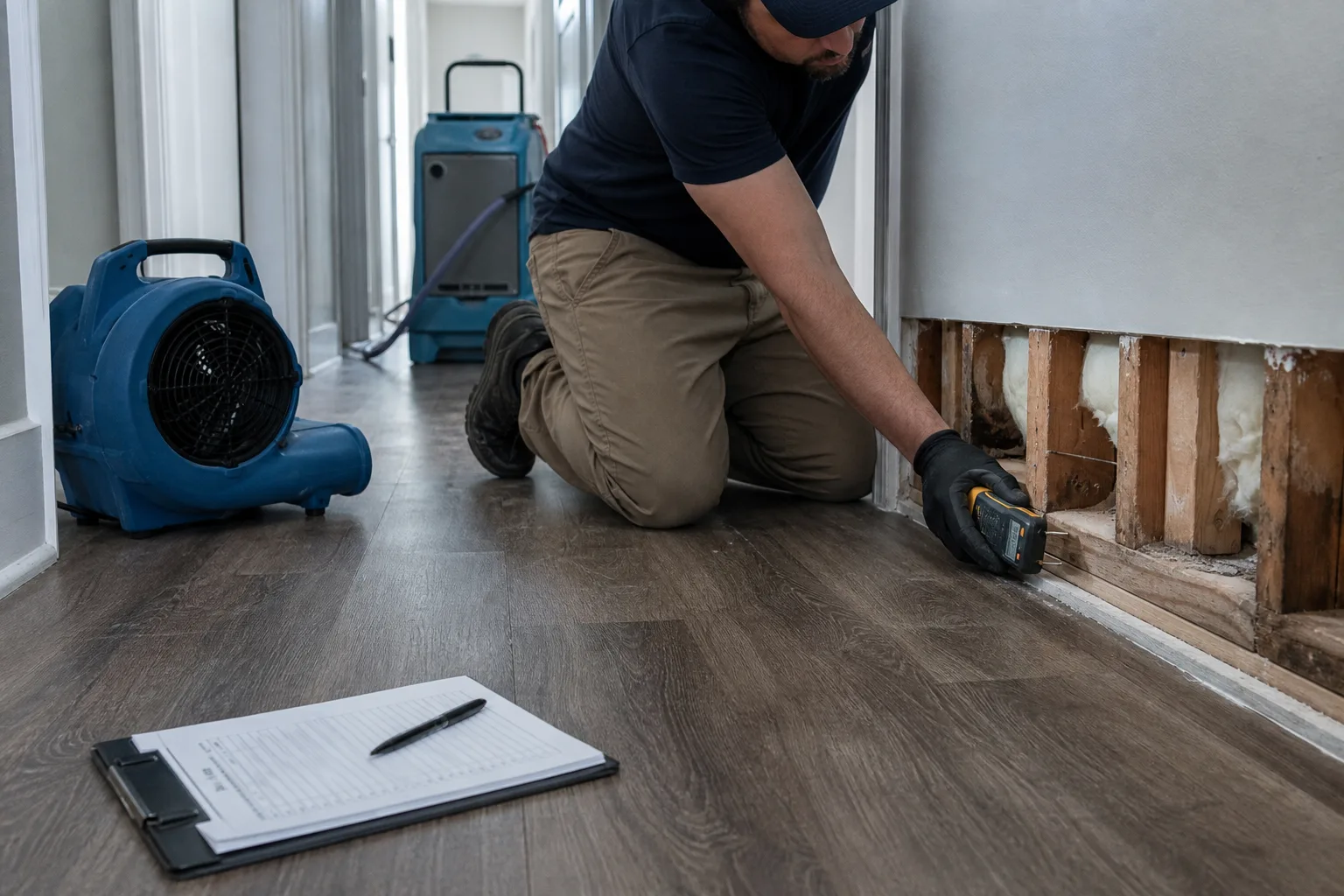
A quarter-inch icemaker line let go behind a refrigerator in a two-story colonial and ran for most of a workday before anyone came home. Water tracked under the kitchen laminate, through the doorway, and down the hall to the base of the stairs. Extraction happened that evening, three air movers and one dehumidifier went in, and on the morning of day four the technician took readings, said the numbers looked good, and loaded the equipment. Eleven days later the hallway baseboard began to cup and the bottom of the door casing darkened. Nothing on the log was false. The readings had simply been taken on the face of the drywall, at knee height, in a hallway where the water had gone under the plate.
Who sets the dry standard, and when they set it
Drying does not end at a number somebody remembers from a class. It ends when the wet material reads the same as the same material, in the same building, that never got wet. That comparison reading is the dry standard, and whoever takes it on the first visit has quietly decided when the job is finished, because every later reading is judged against it. In the colonial, the dry standard for framing came off a stud in a closet on the opposite side of the house, which was reasonable, and the dry standard for the hallway plate was never taken at all. A homeowner who asks, on day one, which unaffected materials were sampled and what they read has moved the decision back into a room where they are standing.
Experienced crews write those baseline readings down before any equipment is placed, because after the dehumidifier runs for two days the whole house has shifted and there is no clean comparison left to take. The habit is not caution. It is the only way to prove later that the structure reached the condition it was in before the loss, which is the standard an adjuster is actually buying and the standard the reader is actually paying for.
Two meters, and the reason both go in the bag
A pinless meter reads a field a fraction of an inch into the material and gives a relative number fast, which makes it the right tool for scanning a floor to find the edge of the wet area. A pin meter drives two electrodes into the wood and reads the resistance between them, which makes it the right tool for a specific point at a specific depth, including the bottom plate behind a drilled hole. The scan finds the problem. The pins prove it is gone. Crews that have done a few hundred of these carry both and use them for different questions, because a pinless reading through laminate, tile or a vapor barrier is measuring the covering as much as the substrate under it.
Repeatability matters more than precision. The same instrument, in the same marked spots, read by the same person, produces a trend line that means something even if the absolute numbers are arguable. Technicians who mark their reading points on the wall in pencil, number them, and photograph the sequence are not being fussy. They are building the only record that can distinguish a wall that dried from a wall that was measured somewhere else on Thursday.
The air readings nobody asks about
Moisture leaves a material only if the air next to it can accept it, which is why the second set of numbers on a competent log is not about walls at all. A thermo-hygrometer gives temperature and relative humidity, and from those the technician gets grains per pound, the actual weight of water the air is carrying. Three readings tell the story: the affected area, the air coming out of the dehumidifier, and an unaffected room or the outside. If the dehumidifier outlet is not markedly drier than the room, the machine is undersized, iced, full, or wrong for the conditions, and the fans are just moving wet air around at the customer's expense.
That single comparison catches most stalled jobs on day two rather than day six. It also catches the opposite problem, where a crew turns a house into a wind tunnel, drives the surface dry, and reports success while the core of the framing is still saturated. Surfaces dry first and fastest. The Environmental Protection Agency is responsible for federal guidance on moisture and mold in buildings, and the practical thrust of that guidance is unglamorous: get the water out of the assembly, not off the paint.
The daily log, and what an equipment line actually bills
The paperwork that makes drying manageable is one page repeated. Date, time, technician, exterior conditions, air readings by location, material readings by numbered point, equipment count and placement, and any change to the plan. Four days of that page is a drying log, and it is the document an adjuster reads to decide whether five days of equipment was necessary or whether day five was an unattended machine collecting a rental rate. Restoration invoices bill dehumidifiers and air movers per unit per day, so the log is simultaneously the technical record and the justification for a substantial part of the price.
The leverage here sits with whoever authorizes the next day. In practice that is often assumed to be the contractor, sometimes the adjuster, and rarely the homeowner, though the signed work authorization usually says otherwise. A reader who asks at each visit what the readings were, what the target is, and how many more days the crew expects, has converted an open-ended rental into a decision with a visible end. Crews that have done this many times prefer that conversation, because it is far easier than defending day seven after the fact.
The signature at the end, and what it closes
The last form is a certificate of completion or satisfaction, and it is a different animal from the work authorization signed on the first night. The authorization lets the crew work and assigns payment. The completion certificate says the drying goal was met and the work is accepted, and it is frequently the document a contractor points to when a floor cups three weeks later. Before signing, the useful move is to ask for the final readings at each numbered point alongside the dry standard from day one, on paper, and to walk the affected rooms while the equipment is still sitting there.
If a point has no final reading, or the final reading came from a different location than the initial one, that is a question to raise before the truck loads rather than after. Most crews will take the reading on request in about ninety seconds. The industry reference for this work, the S500 standard, is built around exactly that documented comparison, and the technicians who follow it closely tend to be the ones who welcome the check.
The homeowner in the colonial got the hallway opened, the plate dried properly, and the baseboard replaced, because the original log was detailed enough to show what had been measured and what had not. That is the quiet argument for the paperwork. It does not slow the job down. It just makes the finishing decision belong to someone who can see the numbers.