Finance
Every Exclusion Was Written After Somebody's Claim. How to Read Yours Backward
A veteran claims advocate's method for dating an exclusion clause, finding the loss it was written to stop, and identifying who is paid by whom to explain it to you.
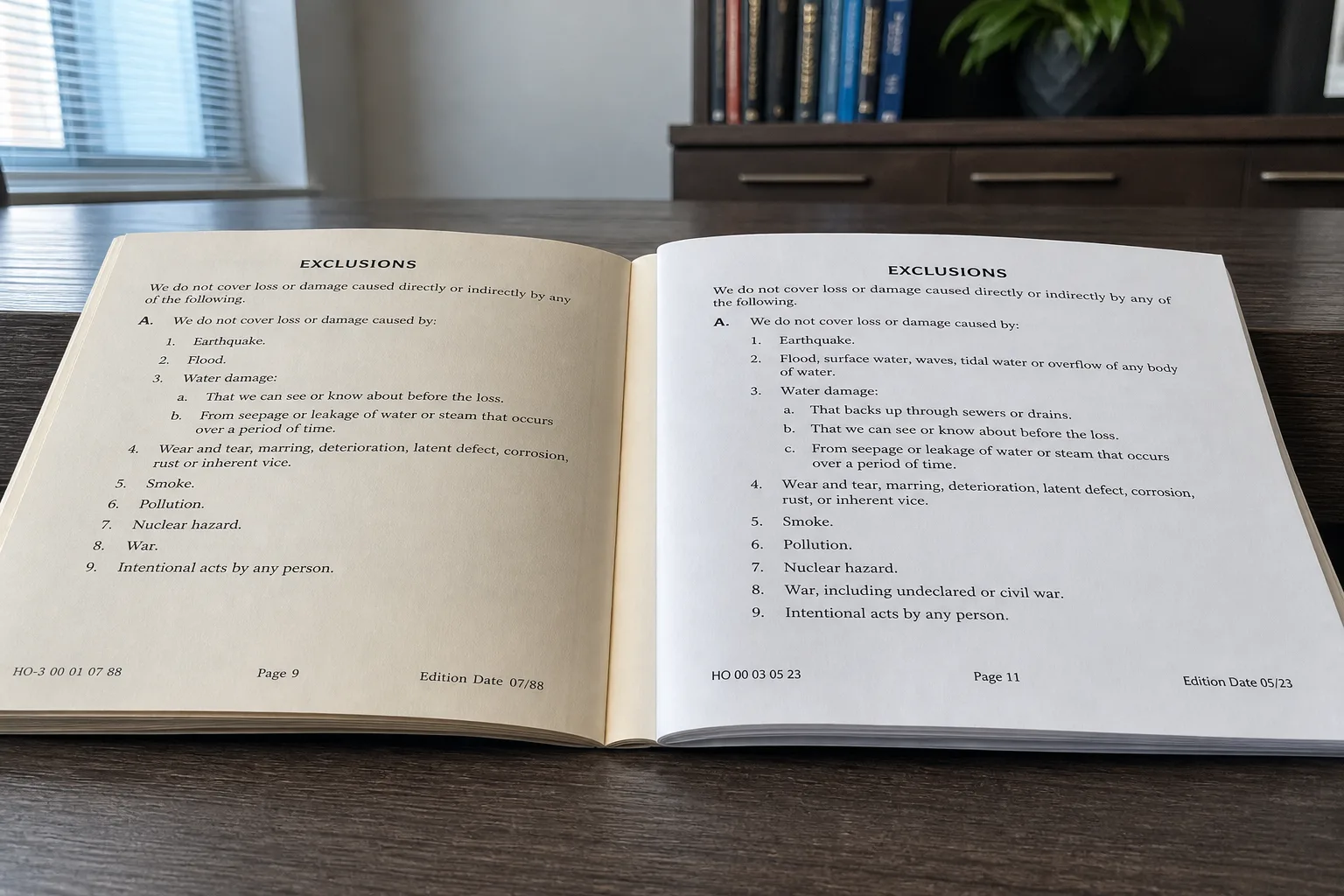
A claims consultant in Harris County keeps two homeowners forms in the same folder, one issued in the early nineties and one issued a decade later, because the comparison does more work in a first meeting than any amount of explanation. Both cover a frame house. Both exclude flood. The later one carries a short paragraph limiting what the insurer will pay to remediate mold, with a flat dollar cap that sits far below the cost of opening a wall cavity and drying a structure properly. Nothing about mold changed between those two printings. What changed was litigation, and the clause is the record of it.
She has run that comparison, by her own count, several hundred times, for homeowners who arrived convinced that the exclusion was aimed personally at them. It almost never is. An exclusion is a scar. Somewhere behind each one is a loss an insurer paid, or was ordered to pay, and did not intend to pay again, and the sentence in front of you is the drafting response. Reading it backward, from the claim to the clause rather than from the clause to your situation, is the only approach that reliably tells you what the words are doing.
Start with the edition date, not the first sentence
Every standard form carries an edition identifier, usually a form number and a month and year, printed small at the foot of the page or in a corner of the declarations. Find it before you read a word of the coverage grant. That date tells you which generation of drafting you are holding, and it tells you whether an exclusion that worried you was present when the house was first insured or arrived quietly at a later renewal. Policyholders who keep their old declarations pages can place the change to a single policy year. Those who do not can usually get prior forms from the carrier on request, and should ask in writing.
Find the loss the sentence was written to stop
The pollution exclusion is the clearest teaching example. For years it excluded discharges that were not sudden and accidental, courts spent two decades fighting over what sudden meant, and the industry eventually issued a version that dropped the qualifier and excluded the category more broadly. The anti-concurrent causation lead-in has the same shape. Courts in California had held that where a covered cause and an excluded cause combined, the loss could be covered, so drafters added language stating that the exclusion applies regardless of any other cause contributing concurrently or in any sequence. That sentence looks like boilerplate. It is a direct answer to a line of cases, and after the Gulf Coast hurricanes it became the central fight in thousands of wind-versus-water claims.
The mold limitation in that Harris County folder has the same provenance. A Texas mold verdict drew national attention in the early 2000s, carriers filed revised forms with state regulators, regulators approved them, and the cap became ordinary. Flood sits in a different category again: it is excluded from nearly every homeowners policy because the federal government took the peril on through the National Flood Insurance Program, which the Federal Emergency Management Agency is responsible for administering. Once you know which of those three stories a clause belongs to, you know whether to argue it, buy around it, or accept it.
Ask who paid for the sentence and who is paid to read it to you
The standard forms most carriers use are drafted by an industry advisory organization funded by insurers, filed with state insurance departments, and approved or rejected there. No one in that chain is paid by you. Your independent agent is compensated by commission from the carrier whose policy you buy, which does not make the advice wrong but does explain why endorsement upgrades get mentioned more often than coverage you could simply decline. The staff adjuster handling your claim draws a salary from the company whose money is at stake. A public adjuster works on a percentage of what gets recovered, which aligns the incentive with yours and also means the recommendation to fight is never disinterested. Policyholder-side coverage counsel will tell you their hourly rate or contingency split if you ask, and the experienced ones volunteer it.
Read the give-backs before you concede the exclusion
Exclusions are rarely absolute, because an absolute one would be unsalable. The money usually sits in the exceptions: the ensuing loss clause that restores coverage for resulting damage from a covered peril, the carve-out for sudden and accidental discharge, the endorsement that buys back a higher mold limit for a modest premium. The consultant's habit is to mark every instance of the words unless, but, or this exclusion does not apply, and to read those passages first. That is where the drafters conceded ground, and conceded ground is where a claim gets paid.
Keep the declarations page from every policy year in one place, and when a form number changes, ask the carrier what moved. The answer is usually short, specific, and far easier to get before a loss than after one.