Family
Buying a Headstone? The Four People Who Handle It After You Sign
The showroom takes the order, but a setter, a carver, an on-site engraver and a grounds crew decide how the stone actually ages. Here is what each one needs from you first.
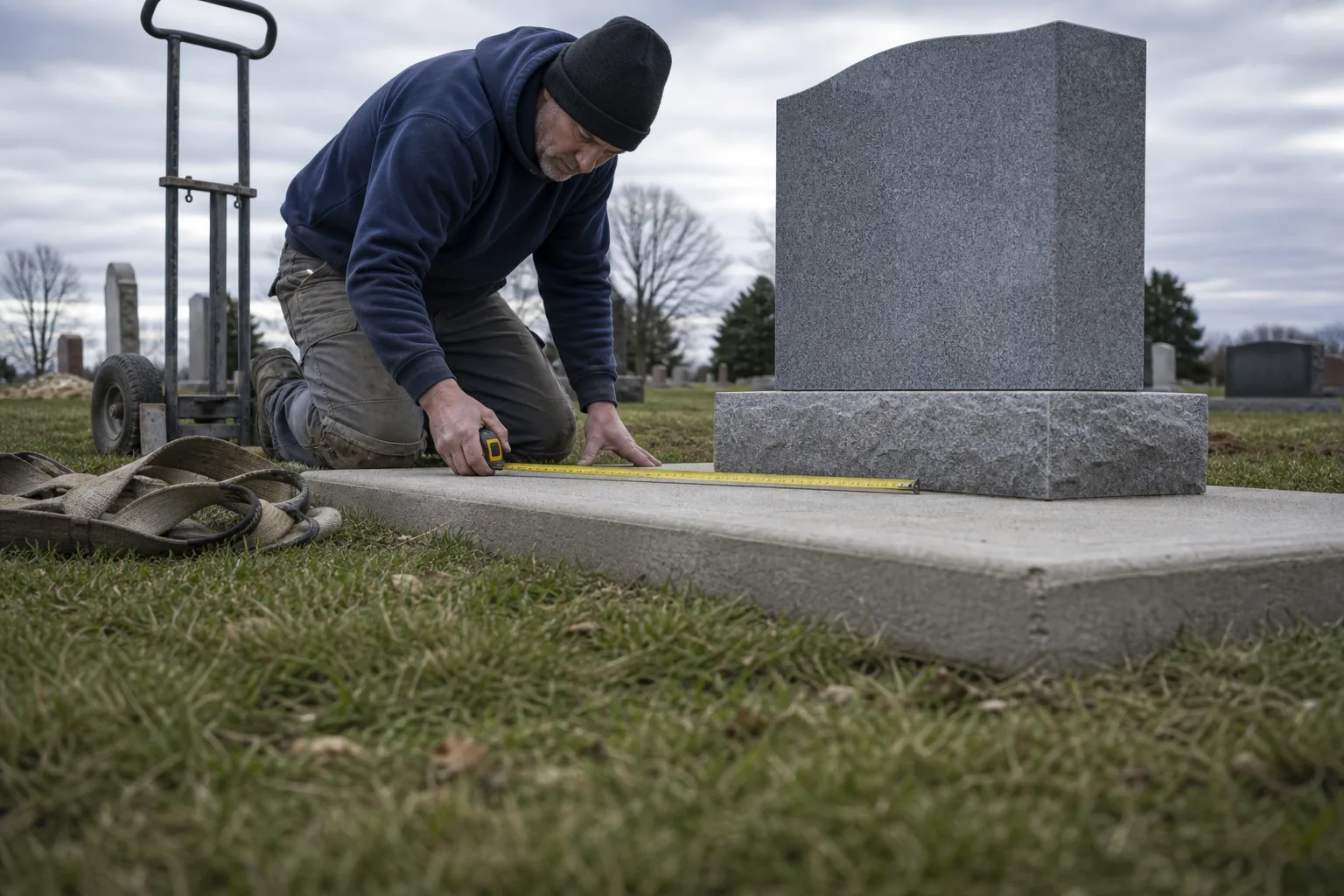
A dark gray granite marker arrived at a cemetery in the second week of April, roughly eleven months after the family signed for it, and the man who came to set it had been doing that work since he was nineteen. He walked the row first, before unloading anything, because the foundation had been poured the previous fall by a different crew working from a different sheet of paper. It was square, it was level, and it was two inches narrower than the base of the stone sitting on his truck. Nobody had done anything wrong. Two people had simply measured from different drawings, months apart, without speaking.
That gap is where most memorial regret lives. The family made its choices in a quiet room with a catalog and a price list, addressed politely throughout, and believed the decisions were theirs alone. In practice the order passed through four sets of hands, each with its own constraints, none of which appeared in the showroom conversation. Understanding what those four people need, and asking them before signing rather than after, is the difference between a stone that sits correctly for eighty years and one that has to be lifted, reset, or lived with.
The setter arrives last and finds out first
Setting is a physical trade with a narrow tolerance. The person doing it is working with a piece of granite that may weigh several hundred pounds, a hand truck or a small boom, ground that has frozen and thawed since the grave was closed, and a foundation someone else poured. He cannot make the base wider. He cannot move the plot line. If the foundation is short, the stone either overhangs, which the cemetery will not accept, or the foundation gets broken out and repoured, which is a separate charge and another season of waiting. Occupational safety on this kind of lifting sits under the Occupational Safety and Health Administration, which is part of why the crew size and the equipment are not negotiable to suit a family's schedule.
Ask the dealer who pours the foundation and who orders it. In some cemeteries the grounds department pours all foundations and bills the family directly, in others the monument company subcontracts it, and in a few the dealer pours its own. Whoever pours it works from dimensions supplied by whoever sold the stone, and the failure point is the handoff between them. A setter with decades in the ground will tell you the same thing every time: confirm in writing that the foundation dimensions on the cemetery's work order match the base dimensions on the sales contract, and confirm it before the granite is cut, not after.
What the carver locks in when the stencil is cut
The lettering is not printed on the stone. A rubber stencil is cut, weeded by hand, and the exposed granite is abraded away with grit under pressure, which means the depth, the width, and the shape of every letter are decided in the shop by a person reading a proof. That proof is the last reversible moment. Once the blast is done, a misspelled name cannot be sanded out, a date cannot be shifted an inch to the left, and a font chosen for the way it looked on a screen cannot be swapped for one with heavier strokes that will still read in raking light forty winters from now.
Carvers who have run thousands of stencils have opinions worth soliciting, and they are rarely asked. They know which typefaces close up when the letters are small, which surnames run long enough to crowd a die of a given width, and how a polished face holds contrast against a steeled or rock-pitched margin. They also know that families almost always underestimate how much text they eventually want. Ask to see the proof at full size, printed, laid against the actual stone width, and read the names aloud from it with a second person. Errors survive proofreading by the person who wrote them.
The second date is a different job, done outdoors
On a companion monument, one death date is cut in the shop under controlled conditions and the other is cut years later, in the cemetery, by someone kneeling on a tarp with a portable compressor. That is a genuinely different job. The engraver is matching the depth and the letter style of work done by someone else, possibly at a different company, in weather, against a surface that has weathered unevenly since. Good on-site engravers do this constantly and the match can be close to invisible. But the space has to exist, and the layout that made the front of the stone look balanced with one name on it may leave the second one crowded low against the base.
This is the decision families most often wish they had made differently, and it is entirely a layout question settled at the design stage. Ask the dealer to show you the proof with both sets of dates filled in, using placeholder years, so you are looking at the finished stone rather than the current one. Ask whether the second date will be cut on site or whether the stone has to be pulled and returned to the shop, because those are different costs and different waits. Ask what happens if the original company is no longer in business, which is a normal question over a thirty-year horizon.
The grounds crew is the reason half the rules exist
Most cemetery restrictions that read as arbitrary in a rulebook are traceable to a person on a mower. Flush markers exist because a crew can cut straight over them. Vase policies exist because a permanent vase is a fixed obstacle that has to be trimmed around by hand, every cycle, forever. Restrictions on ledgers, coping, planted borders, and glass containers come from maintenance history rather than aesthetics. The superintendent enforcing them is not the author of your grief, and the crew is the party that lives with your choice weekly for as long as the cemetery operates.
Talk to the grounds staff, not only the office. They will tell you which sections settle, which corners collect standing water, which side of a stone the afternoon sun hits, and whether the row you are looking at gets trimmed with a string trimmer that will eventually score a soft base. That conversation takes ten minutes, costs nothing, and cannot be reconstructed from a catalog. It is also the one conversation nobody schedules, because the family is being addressed by the sales side and assumes the sales side holds the answers.
Whom to ask, and in what order
Start with the cemetery, because its rules bound everything else, then the setter or the foundation crew, then the dealer, then the carver at proof stage. That order matters, since each party's constraints are inputs to the next one's work, and reversing it produces a signed contract that then has to be renegotiated. Federal price-disclosure requirements for funeral goods are enforced by the Federal Trade Commission, so itemized pricing is available to you by right, and an itemized memorial quote makes it obvious which line belongs to which trade. When the line items name the parties, the questions ask themselves.
The setter in April got his stone in the ground that same week, because the cemetery had a foundation crew on site for another job and the dealer authorized the repour by phone. It worked out. It worked out because three people who had each done this several thousand times recognized the problem in the first ten minutes, which is exactly the expertise a family can borrow, for free, by asking earlier.