Housing
Water Damage on a Thursday Night? The Third Name on the Insurance Check
A supply line fails, a crew arrives within the hour, and the paperwork signed that night decides who controls the money weeks later.
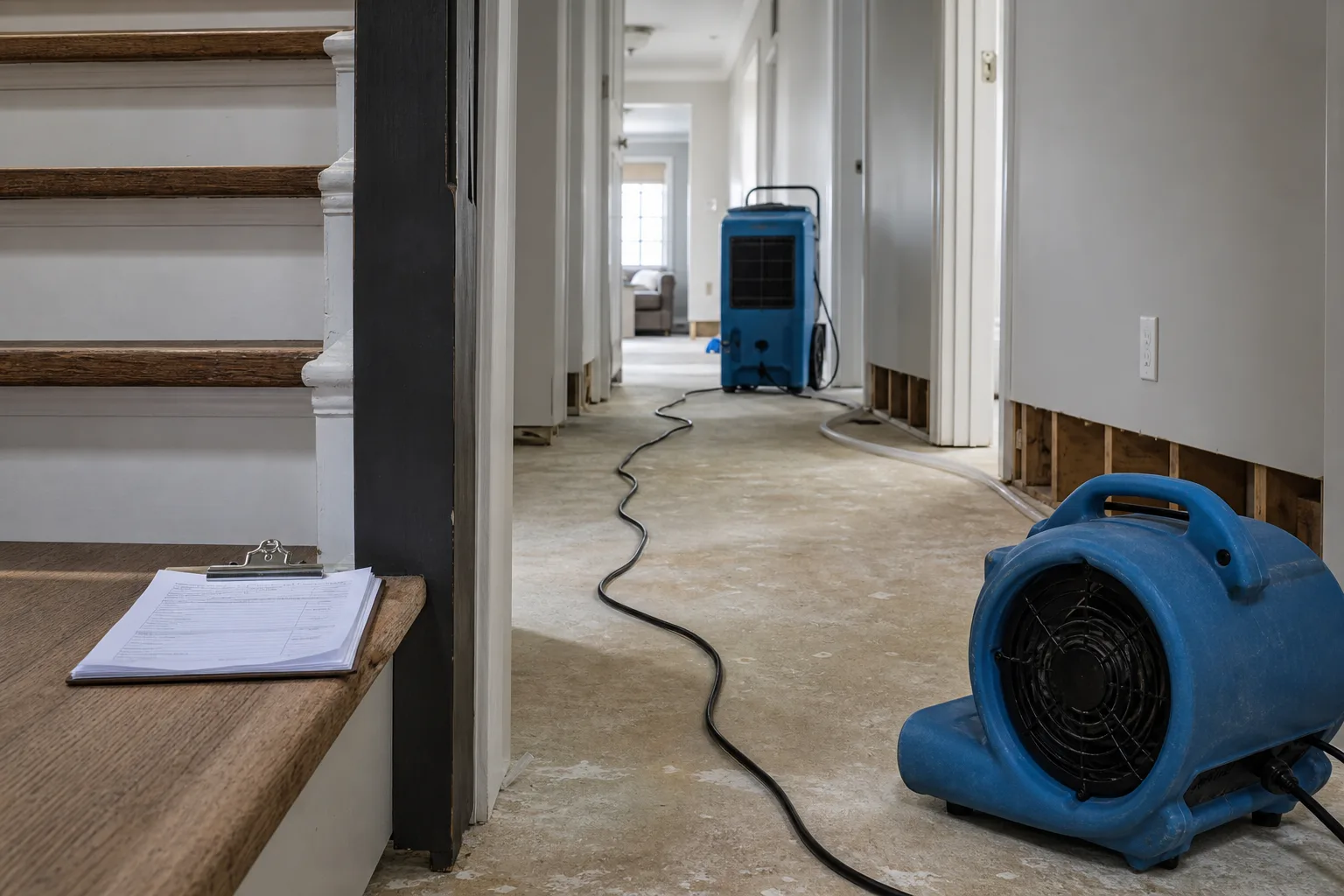
The braided supply line under the upstairs vanity let go around four on a Thursday afternoon, while the house was empty, and by the time anyone came home the water had found the stair stringer, run down inside the wall cavity, and pooled across a finished basement floor two stories below the failure. The homeowner did the sensible things in the right order: shut the main, called the insurer's after-hours line, photographed the rooms. A restoration crew was on site inside ninety minutes. Everything after that went reasonably well except the money, and the money went wrong because of one document signed at nine at night.
The document signed before anyone read it
What the crew lead handed over on a clipboard was not one form but three stapled together: a work authorization giving permission to enter and begin emergency mitigation, an agreement to pay for services regardless of what the insurer ultimately covered, and a direction to pay assigning the insurance proceeds for that work directly to the restoration company. Each of those does something different. The first is unavoidable and reasonable, because nobody dries a house without written permission to be in it. The second and third are where the homeowner's leverage lives, and both were signed at once, in a hallway, with a wet-vac running.
The direction to pay matters most. Once proceeds are assigned, the negotiation over scope and price stops being a conversation the homeowner is in the middle of and becomes one between the restoration company and the adjuster, with the homeowner liable for the gap. Several states now limit or regulate assignment of benefits in property claims, with required disclosure language, cancellation windows measured in days, and caps on what can be assigned. Those rules exist because the pattern is common. Ask which version of that paperwork the state requires, and ask before signing rather than after.
The party whose name is also on the check
Weeks later the insurer issued payment for the dwelling portion of the loss, and the check arrived made out to the homeowner and to the mortgage servicer jointly. This surprises almost everyone. The mortgage is a lien on the structure, the insurance policy protects the collateral behind that lien, and the loan documents signed at closing give the lender an interest in any loss payment above a threshold the servicer sets. The servicer was never mentioned by the adjuster, never mentioned by the restoration company, and never once considered by the homeowner during the two days when every decision was being made.
A servicer's loss draft department has its own procedure, and it is not fast. The check must be endorsed and mailed in, sometimes with a contractor's signed contract, a W-9, a copy of the license, and an adjuster's worksheet. Funds above the threshold are typically released in installments tied to inspections at rough completion percentages, with a field inspector sent out to confirm the work before the next disbursement. The Consumer Financial Protection Bureau oversees mortgage servicing conduct, including how servicers handle escrowed and disbursed insurance proceeds. Calling the loss draft line on day one, before any check exists, costs nothing and changes the sequence entirely.
Here is the reconstruction. The homeowner had committed to a mitigation invoice on Thursday night and, later, to a rebuild contract with a deposit, on the assumption that insurance money would arrive as a lump sum shortly after the adjuster's visit. It arrived instead as a two-payee check requiring a servicer's endorsement and staged release, which meant the rebuild contractor was owed a deposit the homeowner could not yet fund. Nothing improper happened anywhere in that chain. The timing simply did not match, and it did not match because a party with a legal interest in the payment was outside the conversation.
What the standard of care actually requires
Water restoration is not an unregulated field, though it can feel that way at nine at night. The industry standard of care is the ANSI-approved S500 document published by the Institute of Inspection, Cleaning and Restoration Certification, and it governs how a loss is categorized by water source, how affected materials are classified, and what constitutes a dry standard. A technician working to that standard takes moisture readings from unaffected areas of the same materials to establish a baseline, sets equipment based on the cubic volume of the affected space, and logs readings daily until materials reach the documented target rather than until the equipment has run a customary number of days.
That documentation is the single most useful thing a homeowner can ask for in the first forty-eight hours, because it is what an adjuster reviews when deciding whether the drying invoice was reasonable. Ask for the initial moisture map, the daily logs, and the dry standard the crew is drying to. Ask whether the loss has been categorized as clean, gray, or black water, since the category drives whether drywall and carpet pad can be dried in place or must come out. A crew working to the standard already produces all of this. Requesting it changes nothing about their work and everything about the claim file.
The order to run the two days in
Stop the water and document the rooms before anyone touches anything, because photographs taken while the water is still standing are worth more than any later description. Open the claim, get the number, and get the adjuster's name in writing. Then call the mortgage servicer's loss draft department and ask two questions: what the endorsement threshold is, and what documents they will want. Authorize emergency mitigation, because delay causes secondary damage the policy may not cover, but sign only the entry and work authorization if the payment assignment can be deferred. Confirm the company's state license and its certification before the equipment comes off the truck.
Keep mitigation and reconstruction as separate decisions with separate contracts. The crew that dries the house has an obvious interest in rebuilding it, and may well be the right choice, but that is a decision worth making on day five with three estimates rather than on day one with wet socks. Save the failed supply line in a bag, since the manufacturer and failure mode can matter to a subrogation claim the insurer may pursue on your behalf. Write down who said what, with times. A claim is a paper argument, and the paper is made in the first two days.
The homeowner in this case was paid in full, eventually, and the house dried without any structural loss. The delay came from a party who had been in the transaction since closing and was simply never called. Everyone in the chain has a defined role, a set of standards, and a procedure that works when it is triggered early. The work of the first forty-eight hours is mostly triggering them in the right order.