Housing
Crew Wants to Pull the Fans on Day Three? What Separates Dry From Dry Enough
A second-floor supply line, nine air movers and a technician saying the floor feels dry: what actually decides whether a drying job was finished or just ended.
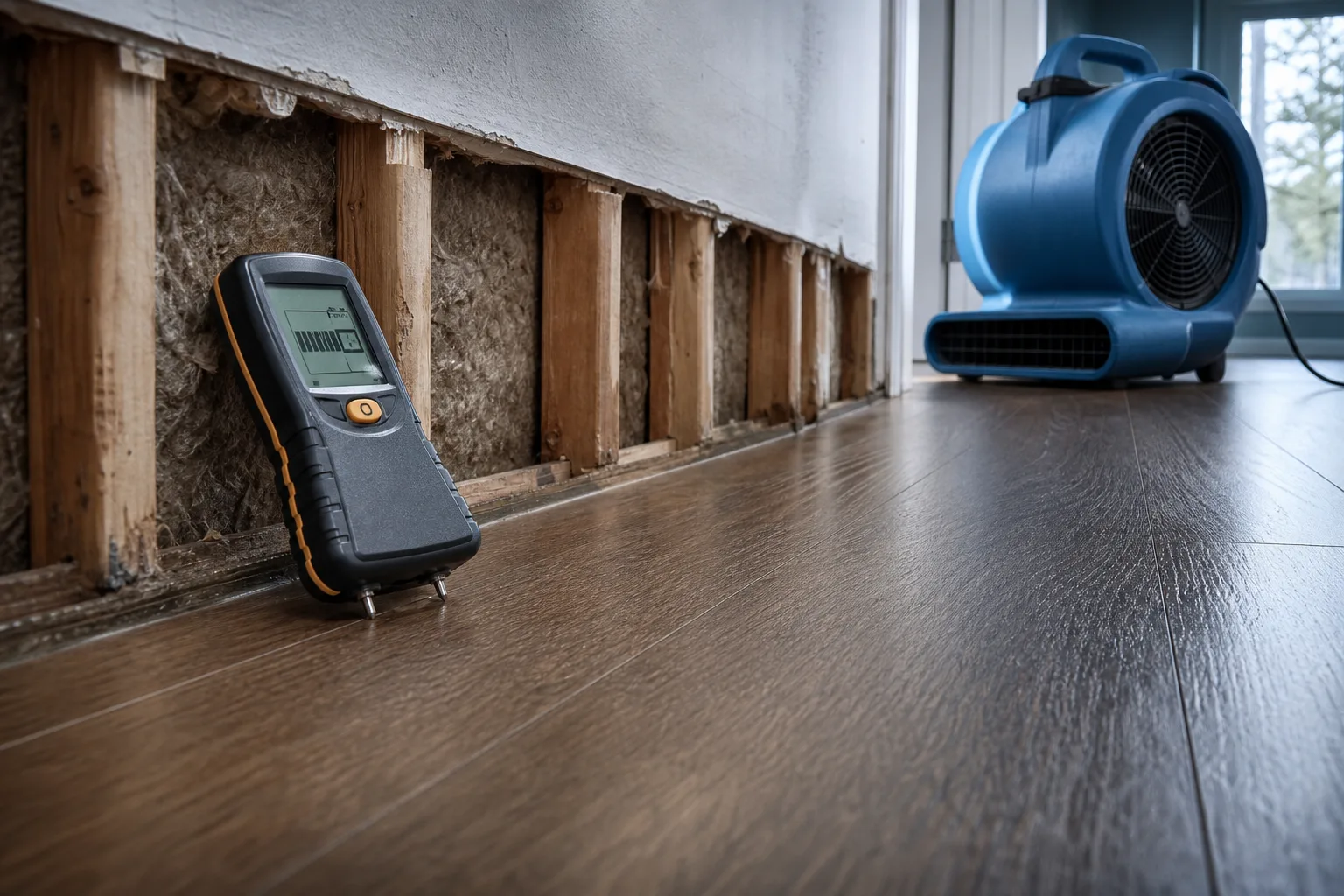
The braided supply line under a second-floor vanity gave way on a Tuesday afternoon while the family was at work, and by the time anyone came home the water had found the seam between the bathroom tile and the hallway oak, run along a joist bay, and started staining the kitchen ceiling below. A mitigation crew arrived that night, extracted standing water, pulled the vanity toe kick, and set nine air movers and one dehumidifier. On Friday morning the lead technician put a hand on the hallway floor, said it felt dry, and began coiling cords. The homeowner asked what the meter said. Nobody had brought one in that day.
Feels dry, reads wet, and the gap between them
Wood and gypsum give up surface moisture fast and core moisture slowly, which is why a floor can feel cool and dry to a palm while the underside of the plank and the subfloor beneath it are still holding water. A pin meter driven into the oak that Friday would have been checking the top few millimeters unless the technician used insulated pins at depth. The relevant comparison is not a number in isolation but a reading taken from the same material in a part of the house that never got wet, the dry standard. If the hallway reads meaningfully higher than the identical oak in the bedroom, the material is not dry, whatever the surface says.
Cavities behave worse. Water that traveled a joist bay sits on the bottom edge of the subfloor, wicks into the joist, and soaks the paper facing of the kitchen ceiling drywall from above, where no air mover pointed at the hallway will ever reach it. Drying that space means either opening it, at the ceiling or through the floor, or pushing conditioned air into it deliberately with a cavity drying system and weep holes behind the baseboard. A crew that dries only what it can see has dried the visible surfaces of a wet assembly, which is a different and much cheaper job.
Who is paying the crew, and for what unit
This is where the incentives stop being abstract. Mitigation work is generally billed to the insurance carrier on an estimating platform with line items for each air mover per day, each dehumidifier per day, the labor to set and monitor, and the antimicrobial application. Priced that way, an extra two days of equipment is revenue, and the old suspicion about contractors leaving fans running an extra week comes from exactly that structure. But most carriers now route these losses through a managed repair or preferred vendor program, and a vendor in that program is measured on average drying days and average claim severity, with continued referrals attached to the scorecard.
Flip the incentive and you flip the failure. A crew whose referral pipeline depends on keeping the average job under four days has a quiet reason to call the floor dry on Friday morning, and no reason at all to open a kitchen ceiling that would move the claim from mitigation into reconstruction. The homeowner is not the one paying, which is the part that matters. The person whose oak floor cups in March had no seat at the table where the drying standard was effectively negotiated, and no one in the room was paid by them.
The log is the difference between two identical-looking jobs
A properly run drying job produces a daily record, and the record is the only thing that distinguishes it from a barely adequate one once the equipment is gone. It should list, for each day, the outside temperature and humidity, the grains per pound of the air inside the containment, the dehumidifier's intake and exhaust readings, and moisture content readings from the same marked points on the same materials, plus the unaffected reference point. Consecutive daily readings that decline and then converge with the dry standard are what finished looks like. Readings taken on day one and day four with nothing between them describe a bill, not a process.
Ask for that log before the fans come out, not after. A crew that has been monitoring properly can produce it from a tablet in about ninety seconds, because the readings were logged as they were taken. A crew that has to build it later is reconstructing a story. The Environmental Protection Agency is the federal body responsible for guidance on indoor mold and moisture, and its position on acting quickly is well known, but speed of response and speed of teardown are separate things. Getting equipment in fast is good practice. Getting it out fast is a claim metric.
What the household can do on day two
Photograph the marked test points on the first day, so the same spots get read again. Buy an inexpensive pin meter and a hygrometer, take your own readings each evening from the wet area and from an untouched room, and write them down with the date. Ask three questions out loud, in front of the technician: what is the dry standard for this material, what did today's reading come in at, and has anything been done for the joist bay and the ceiling below. Ask the same of the adjuster, in writing, so the answer lands in the claim file where it can be referred back to.
That household kept the equipment through the weekend, paid for two additional days out of pocket when the carrier balked, and had the kitchen ceiling opened at the stained bay. The subfloor read eight points above the dry standard on Friday, the morning it was nearly called finished, and reached it on the following Tuesday. Two extra days of rental equipment cost less than the vanity had. The floor never cupped.