Housing
Waited Until Monday to Start Drying? What That Delay Adds to a Water Damage Bill
A supply line fails Friday night and the drying starts Monday. Here is what changes on the invoice in between, and who is paid by whom for the advice you get.
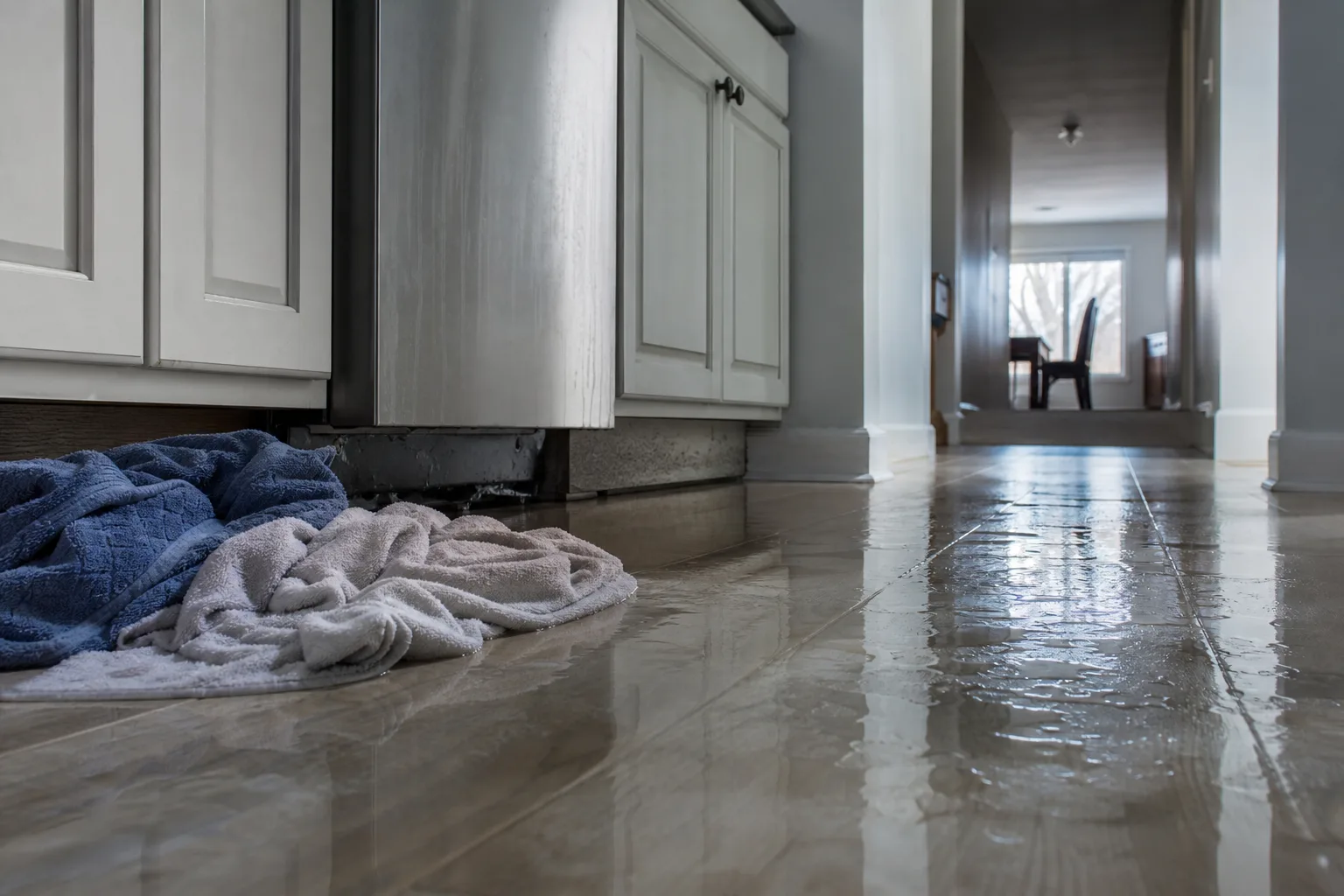
A braided supply line behind a dishwasher in a 1990s split-level let go at around seven on a Friday evening. The homeowner heard nothing, found the kitchen at ten, shut the angle stop, pulled towels from the linen closet, and photographed the floor. Water had already run under the toe kick, followed the seam between the kitchen and the hallway, and soaked into the carpet pad in two bedrooms. She called her carrier's after-hours line, was told an adjuster would reach her Monday, and reasonably concluded that she should wait. That decision, not the supply line, set the price of the job.
By Monday afternoon the drywall had wicked moisture roughly a foot up from the plate in three rooms, the particleboard cabinet bases had swelled at the corners, and the subfloor under the dishwasher read wet on a pin meter well past the point where drying in place is a serious option. Nothing dramatic happened over the weekend. The bill simply changed category.
What the meter is actually measuring
Water mitigation is priced almost entirely on two variables: how much wet area the crew has to control, and how many days the equipment runs inside it. A restoration estimate is built as a set of drying chambers, each with a calculated number of air movers, a dehumidifier sized to the cubic footage, and a daily rate that repeats until the moisture readings come down. Labor for extraction, plastic containment, and moving contents out of the way is separate. That structure is why two houses with identical leaks can be a thousand dollars apart or five thousand apart, depending on whether the water crossed a doorway.
The single largest lever a household controls is the number of days on the meter. Equipment left in place for six days instead of three does not cost twice as much in a loose sense; it costs almost exactly twice as much, because every unit bills daily and the monitoring visits bill separately. Extraction on the night of the loss shortens that count more reliably than anything a crew does afterward. Water removed as liquid never has to be removed as vapor, and vapor is where the days go.
The clock that reprices the job
Clean water from a supply line starts out as the least expensive kind of loss, because materials that are merely wet can usually be dried and kept. Left standing at room temperature against organic material, it stops being clean. Industry drying standards treat that degradation as a matter of time and contact, not opinion, and once a loss is reclassified, the scope changes from drying to removal. Carpet pad comes out. Wet insulation comes out. Drywall gets cut at a set height. The Environmental Protection Agency is responsible for federal guidance on mold in buildings, and the practical consequence of that guidance in a residential job is that porous material with visible growth is discarded rather than treated.
That is the moment the estimate stops being a mitigation invoice and starts including demolition, disposal, containment, and eventually reconstruction. The homeowner in the split-level went from a job that would have been extraction, three chambers, and four days of equipment, to one that included cabinet removal, flooring tear-out, and drywall replacement in three rooms. The leak was the same size on Monday as it was on Friday.
Who is paying whom for the advice
The advice you receive in the first two days almost always comes from someone with a financial position in the outcome, and it is worth knowing which position. A restoration company reached through the carrier's emergency line is frequently part of a managed network, which means it has agreed to program pricing and audit terms in exchange for a flow of assignments. Those firms bill the insurer directly, which is genuinely convenient, and they also work to a scope the insurer's software will accept without argument. That alignment usually protects the homeowner from a coverage fight. It also means the crew's incentive is to scope tightly.
An independent restoration contractor you find yourself has the opposite incentive. Their revenue is the equipment days and the square footage, and nobody is auditing the estimate before it is submitted. Neither arrangement is dishonest. But the homeowner should read a recommendation to run four more days, or to remove a wall that reads dry, in light of who is billing for it. A public adjuster, if one appears at the door, is paid a percentage of the settlement and therefore has a reason to enlarge the claim, which is sometimes exactly what a household needs and sometimes not worth the cut.
What the first night is worth in dollars
Extraction on a Friday night, paid out of pocket if necessary, is the cheapest money spent in the entire sequence, and virtually every homeowners policy obliges the insured to take reasonable steps to prevent further damage. That duty works in the homeowner's favor: it means an emergency service call made before the adjuster is reachable is generally reimbursable, provided the invoice is itemized and the photographs are timestamped. Waiting for permission that the policy already grants is the expensive interpretation.
The split-level owner kept every receipt, documented the moisture readings on her phone each morning, and got the mitigation portion paid in full. The reconstruction she is still finishing would not have existed if the crew had arrived Friday.