Finance
Small Loss, Big Deductible? The Folder That Decides Whether You File at All
A $2,600 leak, a $1,000 deductible and one phone call that became a permanent record: how ordinary paperwork settles the file-or-absorb decision before renewal does.
The repair was $2,600. The deductible was $1,000. A supply line under a second-floor bathroom sink had been weeping for weeks, long enough to stain the ceiling below and swell a section of baseboard, and the homeowner did what most people do first: he called his agent's office to ask, in general terms, whether something like that would be covered. He did not file anything. Fourteen months later, shopping the policy after a renewal increase, three carriers came back quoting him as a household with recent water loss activity. Nobody had lied to him. He had simply not understood which conversations leave a mark.
Working backwards from the quote to the phone call
The decision that made the outcome likely was not the leak and not the repair. It was making the coverage question a phone call to the carrier rather than a question answered at his own kitchen table. Insurers keep records of contacts that reference a specific loss at a specific address, and loss-history reporting is the kind of consumer file the Federal Trade Commission oversees under fair credit reporting rules, which means it is disclosable to you and correctable by you. He had a right to see it. He had never looked, because he had never had a reason to think the file existed.
What he needed, before dialing anyone, was the arithmetic he could have done himself in twenty minutes. Repair cost minus deductible. The recoverable amount against the value of a claim-free discount he was already receiving. On a $2,600 loss with a $1,000 deductible, the check is $1,600 before any depreciation holdback, and a surcharge spread across three renewal cycles can eat most of that. The number does not always come out against filing. It came out against it here, and he could have known.
What belongs in the folder before anything goes wrong
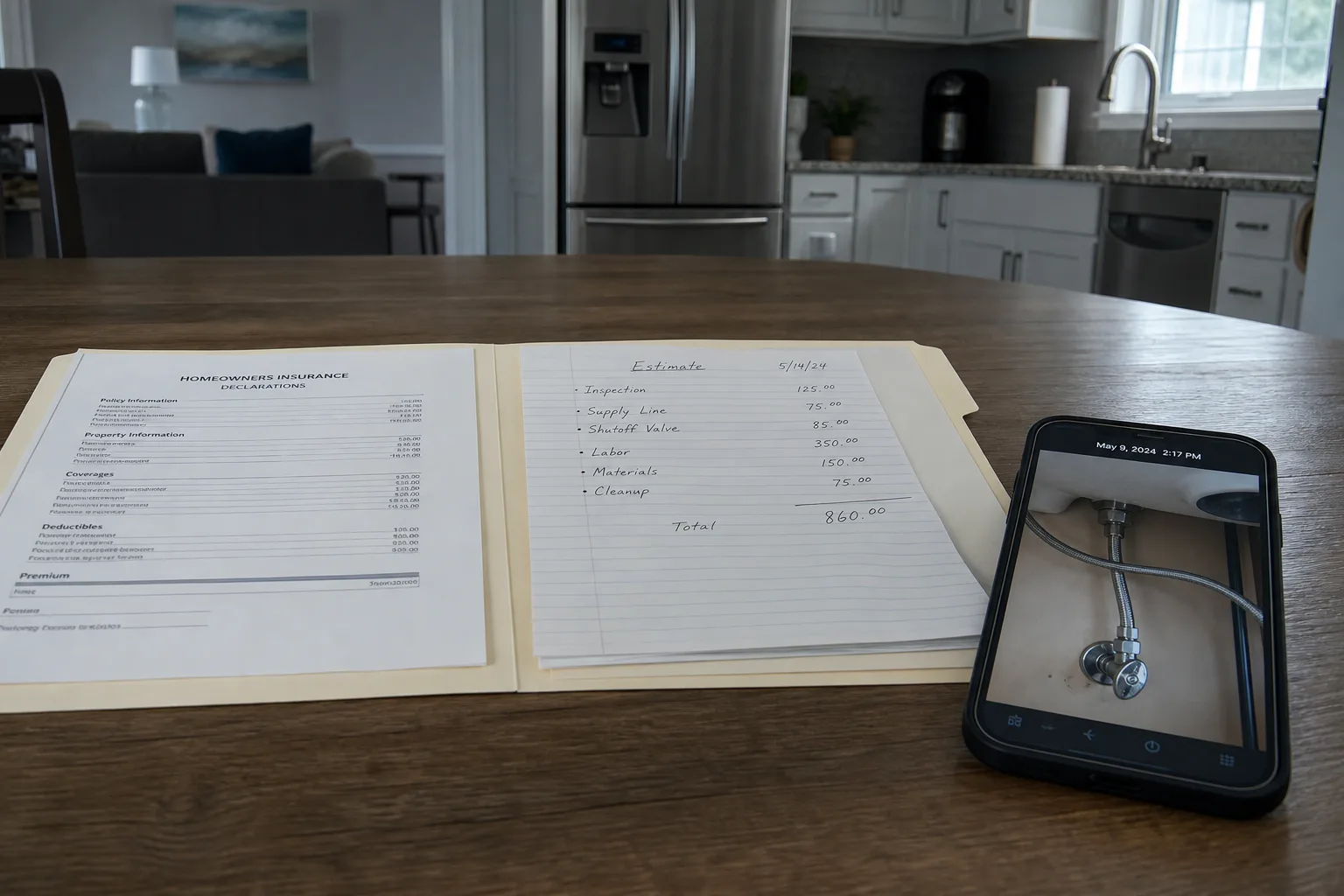
The folder is not elaborate. A copy of the declarations page, current and the one before it, so you can see what the deductible actually is rather than what you remember choosing. The full policy form, not the summary. A one-page note of your renewal date and the date of your last paid claim, because both figures drive pricing and both are easy to misremember by a year. Your own loss-history report, pulled directly and read for accuracy. Contact details for two contractors who will write a real estimate, on letterhead, without a claim attached to it.
That last item is the one people skip and the one that does the most work. An independent estimate turns a vague coverage question into a fixed number, and a fixed number is what the file-or-absorb decision runs on. It also protects you in the other direction: when a loss is genuinely large, the estimate you already have keeps the adjuster's first figure from becoming the only figure on the table. Getting an estimate is not a claim. It creates no record with any carrier.
The week-to-week part nobody photographs
Most of this is maintenance habit rather than insurance work, and it happens in fifteen-minute stretches. Once a month, phone in hand, walk the shutoffs: under both bathroom sinks, behind the toilet, the washing machine hoses, the water heater pan. Photograph the braided lines and the dates stamped on the water heater. The photos time-stamp themselves. Twice a year, do the same on the roofline and gutters after a storm, and again in a dry week so you have a clean baseline. Keep the receipts from any plumber, roofer or HVAC visit in the same folder.
The point of the baseline photograph is that it answers the question adjusters ask about every water and roof loss, which is whether the damage was sudden or the end of a long deterioration the policy excludes. A homeowner who can produce a clear picture of an intact ceiling from eight weeks earlier has settled that argument without an argument. The same photograph, taken early enough, is often what tells you to replace a $14 supply line before it ever becomes a claim question.
Asking the question without creating the record
When the coverage question is genuinely unclear, ask it of someone who does not underwrite you. An independent agent who represents multiple carriers can discuss a hypothetical without opening a file. Your state's department of insurance answers coverage questions from consumers directly. A public adjuster will read a policy for a flat fee. Any of those routes gets you the same answer the carrier would give, at the same reliability, with nothing attached to your address. Save the call to your own insurer for the moment you have decided to file, and then make it promptly and completely.
He absorbed the $2,600 in the end, and the next renewal came in flat once the inquiry aged off. The folder now lives in a drawer with the tax paperwork, four pages thick, updated each January when the declarations page arrives.