Legal Affairs
Six Weeks With No Appointments, and the Folder That Would Have Explained Them
Working backwards from a stalled injury claim to the ordinary week in month two when the record stopped, and comparing the three ways people arrive at a first legal meeting.
The claim did not fall apart in a deposition or at a hearing. It fell apart in a letter from an adjuster, eleven months after a rear-end collision on a Tuesday afternoon, and the sentence that did the damage was a short one: the file showed no treatment between the second week of March and the last week of April. Six weeks. The driver had not recovered in that window, and had not decided the injury was minor. He had run out of paid time off, his clinic scheduled physical therapy only on weekday mornings, and his copay had reset. Nobody wrote any of that down while it was happening.
The week the record stopped, and why
Reconstructed afterward, the six weeks were unremarkable. Week one of the gap, he swapped a therapy slot for a shift he could not afford to miss. Week two, his wife was traveling and there was nobody to cover the school pickup that the appointment collided with. Week three, he called the clinic to reschedule, got voicemail, and did not call back. By week five the pain had settled into something he described to himself as manageable, which is the word people use when the alternative is another unpaid morning. Every one of those decisions was reasonable on the day it was made.
What made the outcome likely was not the gap itself but the absence of any contemporaneous account of it. An adjuster reading a bare treatment history sees a person who stopped hurting and then started again once a lawyer got involved. A voicemail log, a text to a supervisor about a swapped shift, a screenshot of the clinic's morning-only schedule: any of that turns six blank weeks into six documented ones. The material existed. It sat in a phone, unsorted, until it was needed and then could not be found.
Three ways people show up, and what each one buys
The first version arrives with memory and a police report number. It is the most common, and it is not useless, but it converts the first meeting into an interview about what might exist rather than a review of what does. The attorney spends the hour building a list of records to request, and the client leaves with homework instead of an assessment. The second version arrives with a box or a phone gallery: every bill, every discharge sheet, photos of the bumper, nothing in order. That is better, because the raw material is present, but sorting is billable or it is delegated, and either way it happens after the meeting rather than during it.
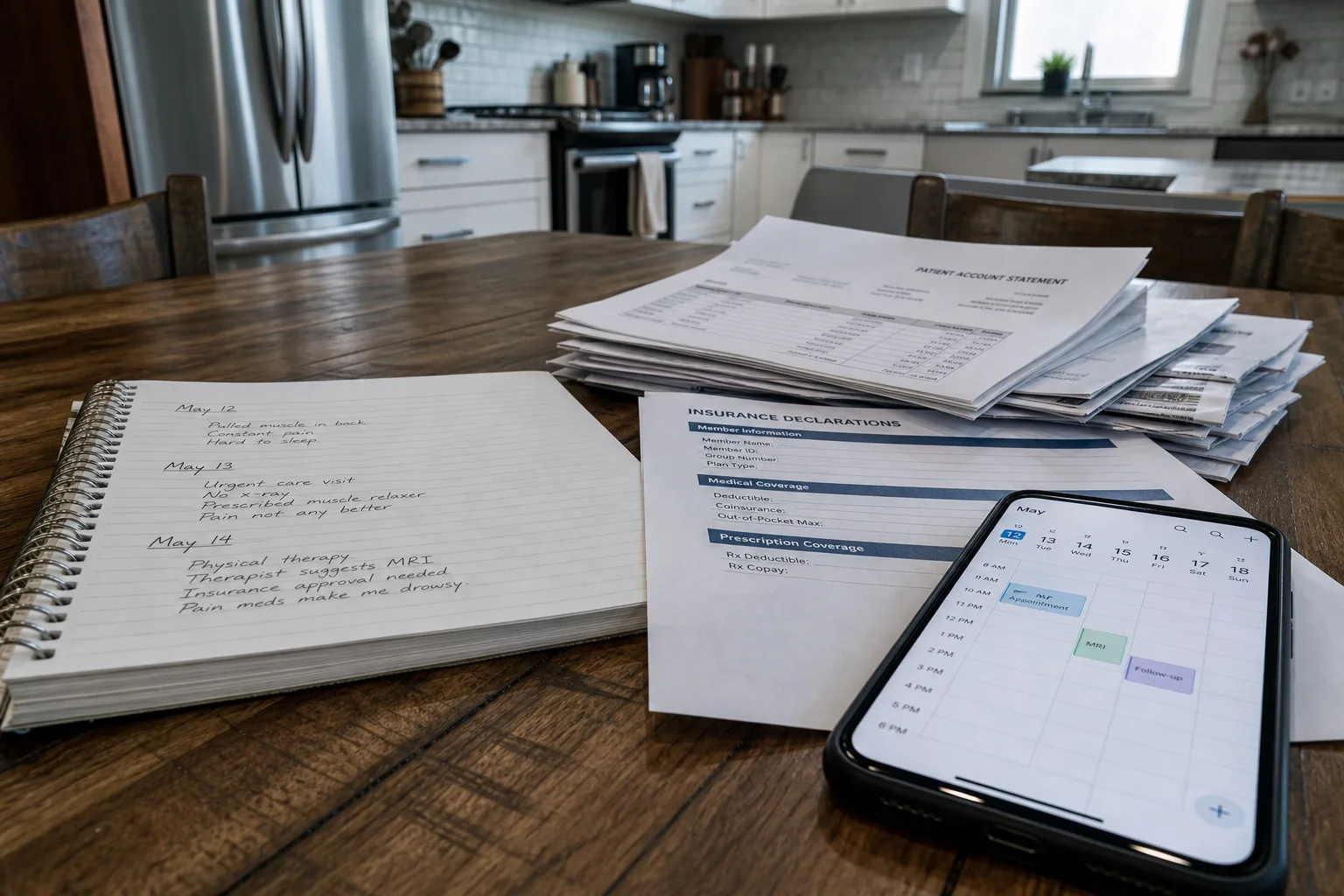
The third version is a running record kept week by week from the first day, and it changes the character of the meeting entirely. It is not more documents. It is the same documents plus a dated line for each week saying what happened, what treatment occurred or did not, what work was missed, and what hurt. Fifteen minutes on a Sunday. The difference in outcome is not that the third client is more organized; it is that the third client has preserved the explanations that only exist while the week is still fresh.
What the running record needs in it
Weekly entries do the heavy lifting: the dates of every appointment attended and every one missed with the reason, the hours or shifts lost with who at work knew about it, the mileage to and from providers, the out-of-pocket amounts including the pharmacy runs people forget, and a plain sentence about function rather than pain scores. Could you lift the laundry basket. Did you sleep through. Did you drive on the highway. Alongside that, a single folder holds the crash report, the insurer's correspondence in the order it arrived, photographs of the vehicles and of any visible injury, and the declarations page of your own auto policy, which is where uninsured and underinsured motorist coverage lives.
This is also why a personal injury attorney in oklahoma will often ask about the shape of your ordinary week before asking much about the collision, because the schedule you keep is what determines whether treatment gaps appear in the file at all. Workplace injuries add another layer, since the Occupational Safety and Health Administration oversees employer recordkeeping for job-related injuries, and the internal report your supervisor filed is a document you are entitled to see.
What the first hour looks like with each version
With memory alone, an hour produces a preliminary opinion and a task list. With the box, it produces the same opinion, a little firmer, and a shorter task list. With the running record, the hour turns into an actual evaluation: which coverages are in play, what the medical picture supports, where the weak points in the timeline are and whether they can be explained, and what a realistic sequence of the next several months looks like. That is the difference between adequate preparation and good preparation. Not effort on the day of the meeting. Effort spread thinly across the weeks before it, when the explanations are still true and still remembered.
The driver in the rear-end case eventually reconstructed most of the six weeks from phone records and his wife's calendar, and the file improved. It took three evenings and a written statement, and it recovered ground that a few minutes each Sunday would never have lost.