Finance
A Six Thousand Dollar Ring on a Tray, and the Four Conditions to Attach Before You Pay
An Art Deco ring priced at $6,400 shows how estate jewelry pricing is really built, who set the number, and which conditions a buyer can still attach before the money moves.
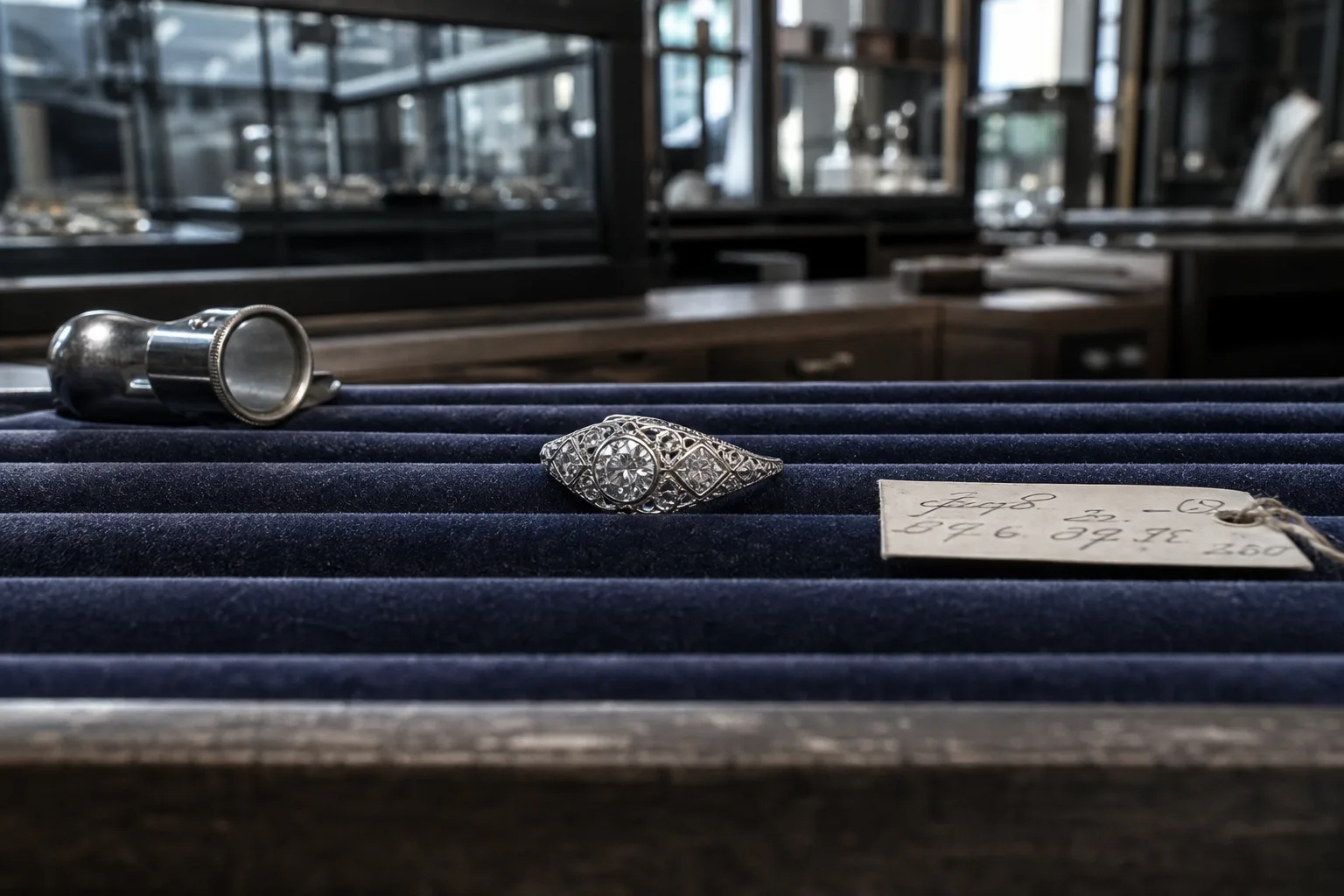
The ring sits third from the left on a velvet tray in a estate jewelry shop in a mid-sized city, and the handwritten ticket says Art Deco, circa 1925, platinum, 1.30 carat center. The price is $6,400. The salesperson is helpful, knows the period, points out the milgrain edging and the filigree gallery under the head, and lets the buyer hold it under the loupe for as long as she wants. Everything said is probably true. The question that matters is not whether the description is honest, but which of the two people standing at that counter is still in a position to decide anything, and about what.
What the $6,400 is actually made of
Very little of that number is metal. The mount holds perhaps six or seven grams of platinum, and while platinum is not cheap, the melt value of a small ring is a rounding error against the ticket. The center stone carries most of the price, and it does not price linearly: a stone at 1.30 carats trades at a higher price per carat than one at 0.90, because size scarcity compounds, and a stone that clears a round number sits in a different bracket than one that misses it by two points. Color and clarity move the figure again, in bands that are invisible to the naked eye and worth four figures apiece.
Then there is the cut, which in an antique ring is a genuine fork in the road. An old European cut has a small table, a high crown, and an open culet, and it returns light in broad flashes rather than the fine scintillation a modern brilliant produces. Some buyers pay a premium for exactly that, and some markets discount the same stone against a modern round of equal weight, because the recut yield would be lower. The dealer knows which of those two markets he is selling into. The mount matters too, and originality matters more than condition: an unaltered period shank with its original head is worth real money, while a handsome antique mount fitted with a later stone is a married piece, and prices differently even when it looks better.
Who set that number, and who can still move it
The ticket was not written by an appraiser. It was written by the owner of the shop, working back from what he paid, and what he paid was decided at a regional auction by a room of other dealers who all stopped bidding at roughly the same place. That floor price is the most informative number in the transaction and the one the buyer will never see. Above it sits a markup that has to cover the months the ring sits in the case, the return policy, the bench work already done, and the losses on the pieces that turn out to be something other than what the ticket said.
Which is why the first question is not about the diamond. Ask whether the shop owns the ring or holds it on consignment. A dealer selling his own inventory can discount it, can send it out for grading, can hold it for a week without payment, and can take it back. A dealer holding a consigned piece for an estate or a private owner controls almost none of that, because every one of those decisions belongs to a person who is not in the building and may take days to reach. Buyers routinely negotiate hard with someone who has no authority to agree, and read the refusal as firmness rather than as structure.
The conditions to attach before the money moves
A buyer's leverage exists in exactly one window, which closes when the card clears. Inside that window, four conditions are reasonable, standard in the trade, and worth insisting on. The first is an independent laboratory report on the center stone, at the buyer's expense if necessary, with the sale contingent on the report matching the ticket within a stated tolerance on weight, color, and clarity. The second is a written statement of treatments, because clarity enhancement in diamonds, glass filling in rubies, and heat or diffusion in sapphires all change the value substantially and none of them are visible across a counter.
The third is a repair and alteration history in writing: retipped prongs, a replaced shank, a re-cut stone, a head swapped in the 1970s. None of these are disqualifying, and all of them belong in the price. The fourth is the return policy in writing, with one specific detail confirmed, which is whether resizing voids it. It almost always does, and a buyer who resizes on Monday and gets the lab report on Thursday has spent the return window on a ring that no longer fits back into the original terms. The Federal Trade Commission is responsible for how precious metals and gemstones may be described to consumers, and a seller comfortable putting those descriptions in writing is telling you something useful before the report ever arrives.
The appraisal that comes with the ring, and the one you pay for
Estate pieces often come with an appraisal already attached, sometimes in a plastic sleeve, sometimes with a number noticeably higher than the ticket. Buyers read that gap as evidence they are getting a deal. It is usually evidence of nothing, because an insurance replacement appraisal answers a different question than a purchase price does: it estimates what it would cost to replace the item at retail, promptly, in a market where the buyer has no time to shop, and it is written for an insurer's schedule rather than as an opinion of what anyone should pay today.
Fair market value, the number a resale or an estate settlement would use, sits well below that, and the spread between the two is not a discount. If you want an independent opinion, pay for it yourself, hire someone with no financial interest in the piece and no offer to buy it, and say plainly which value you are asking for and why. That appraisal costs a few hundred dollars against a mid four figure purchase, arrives after the sale in most cases, and is the reason the return window matters so much. A dealer who structures the sale so that the independent report lands while you can still walk away has answered the only question about his confidence that counts.
What the case generalizes to
The pattern holds well beyond one ring on one tray. In any purchase where the value is not visible in the object, and jewelry, watches, coins, and small antiques all qualify, the party who set the price did so from information the buyer does not have, and the buyer's only real instrument is the condition attached before payment. Not the negotiation, which mostly moves a few hundred dollars, and not the appraisal in the sleeve, which answers someone else's question. The condition. Ask who owns the piece, ask what can be verified and by whom, ask what happens if the verification disagrees with the ticket, and get the answers in a form you could hand to a third party later.
The buyer who walks out with that ring for $6,400 and a lab report matching the description has bought well, and probably at a fair price, because the shop's markup is the cost of a dealer having found the piece, carried it, and stood behind it. What she has actually purchased, though, is not the discount she thinks she negotiated. It is the certainty, and that was available for the price of four questions asked in the right order.