Housing
A Restoration Truck Outside at Midnight, and Which Decisions Are Actually Still Yours
In the first two days after a water loss, three separate documents change hands. Only one of them has to be signed that night, and knowing which is the whole skill.
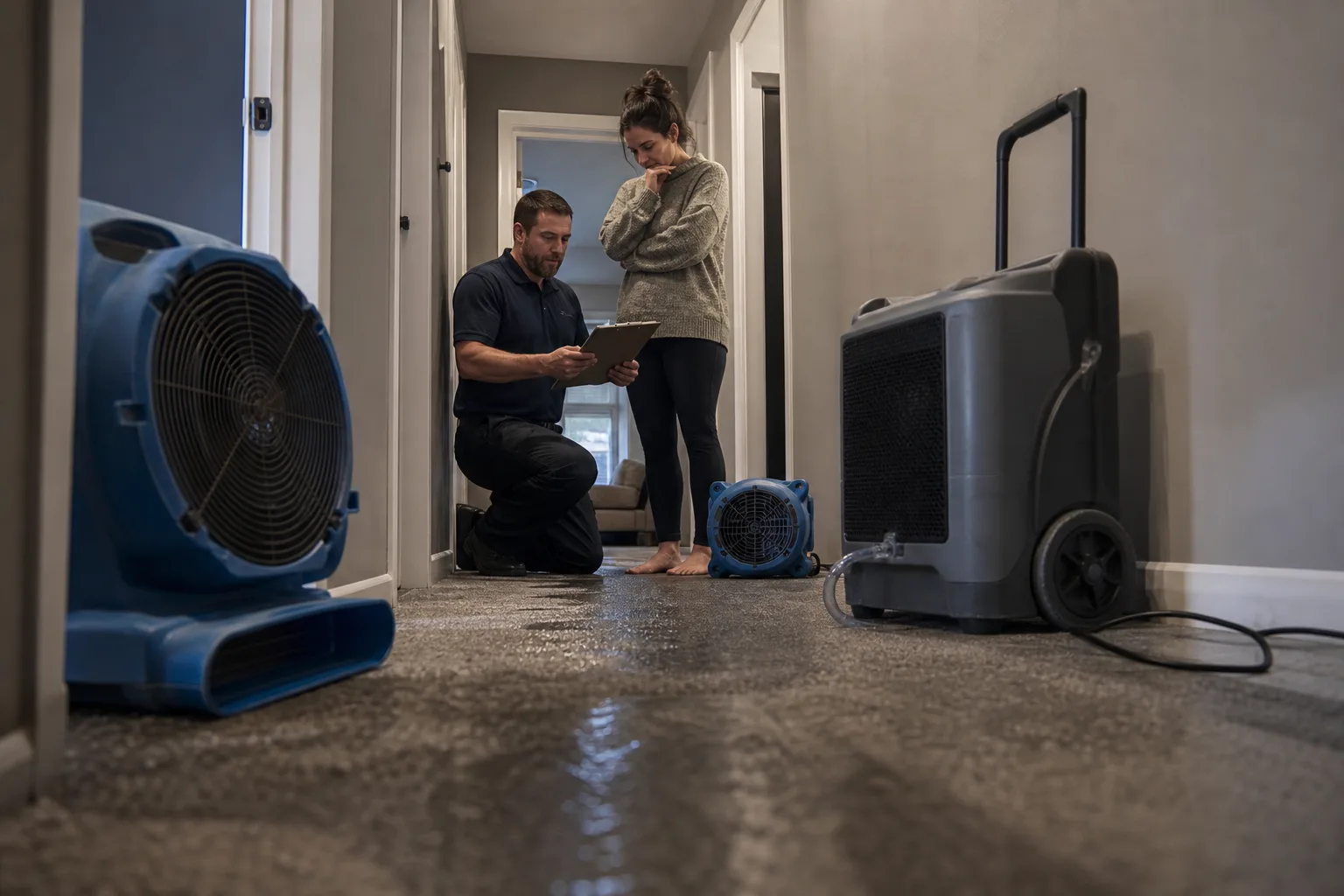
A braided supply line under a second-floor vanity let go on a Saturday night in a house where everyone was asleep. By the time the sound of water on the stair treads woke someone, the ceiling below had a stain the size of a card table and the hall carpet squelched underfoot. The homeowner shut the main off at the street, called the insurer's after-hours line, and was given a claim number and the names of two restoration firms. One of them had a truck in the driveway inside ninety minutes. The technician was competent, calm, and holding a clipboard with three separate documents on it.
That clipboard is where the real decision sits, and almost nobody sees it clearly at one in the morning. The homeowner in this case signed all three, because the technician presented them as one packet and because the water was still dripping. Two of the three were reasonable. The third gave away something that was hard to get back, and it was not the expensive one. Understanding which is which is the single piece of judgment worth building before you ever need it.
The three documents, and what each one actually hands over
The first is a work authorization: permission to enter, extract standing water, pull soaked carpet pad, and set drying equipment. It is narrow, it is urgent, and it should name the emergency services only. Sign it. The second is an acknowledgment of the equipment placed, usually a count of air movers and dehumidifiers with a daily rate attached. Sign it too, but read the count and walk the house to confirm it, because that number is what gets billed per day whether or not the machines are the right ones for the space.
The third is the one to slow down on. Depending on the state and the firm, it will be called a direct payment authorization, an assignment of benefits, or a lien on insurance proceeds, and what it does is move you out of the middle of the money. The contractor bills the carrier directly and, in the stronger versions, gains the standing to negotiate or dispute the claim in your place. That can be a convenience. It can also mean a scope disagreement gets settled between two parties, neither of which is you, over work performed on your house.
Who chose the company, and who was allowed to
The two names given over the phone came from the insurer's preferred vendor program, and the homeowner reasonably heard that as an instruction. It is not one. In nearly every state, the policyholder selects the contractor, and the carrier's role is to determine what the policy covers and what a reasonable cost for that work looks like. A preferred vendor typically has a pricing agreement with the carrier and often a warranty backed by it, which is a genuine advantage on a straightforward job. It also means the firm has an ongoing commercial relationship with the party paying the bill, and you should know that before you decide, not after.
The decision that matters in hour two is not which company is best. It is who is standing in the house drying it out, which is a smaller and more reversible decision than the one people think they are making. Emergency mitigation and reconstruction are separate scopes and can be separate firms. Letting a preferred vendor dry the structure while you take a week to choose who rebuilds the ceiling and replaces the flooring is normal, permitted, and often the sharper move.
The readings are the evidence, and they are yours to ask for
Judgment in a water loss comes from measurements, not impressions. A competent technician takes moisture readings at the outset, marks the affected area on a sketch, classifies the water by source (clean supply line, appliance discharge, sewage) and the category of damage by how much material is wet, and then logs readings daily until the materials return to a dry standard. Ask on the first night for the initial readings and the drying plan. Ask each day for that day's numbers. A firm that produces them without friction is telling you something useful. So is one that does not.
Those same readings decide the questions that get expensive later: whether drywall is dried in place or cut out, whether cabinet toe kicks come off, whether hardwood is salvageable or already cupping past recovery. The Environmental Protection Agency is responsible for federal guidance on indoor mold and moisture, and the operating principle in that guidance is unglamorous and firm: material that stays wet becomes a different and larger problem, and speed of drying is what prevents it. That is why the emergency authorization is worth signing at once, and why the payment assignment is not.
Building the judgment before the water arrives
You can do most of this in a quiet hour on a weekend. Find your declarations page and read the water damage section, the deductible, and whether you have replacement cost or actual cash value on contents. Photograph each room while it is dry. Learn where the main shutoff is and confirm the valve turns. Write down one restoration firm you would call by name, chosen when you were not under pressure, alongside the carrier's claims number.
The homeowner with the failed supply line got a good outcome in the end, because they went back on Monday morning, asked for the assignment to be limited to the mitigation invoice only, and got it. Restoration firms deal with that request routinely. It reads as a difficult conversation and turns out to be a five-minute one, which is true of most of the choices that stay yours in the first two days.