Housing
Restoration Crew at the Door at Midnight? The Signature That Decides Who Controls the Job
The first forty-eight hours after water damage are governed less by one national rulebook than by a signature, a state license law, and a local disposal rule.
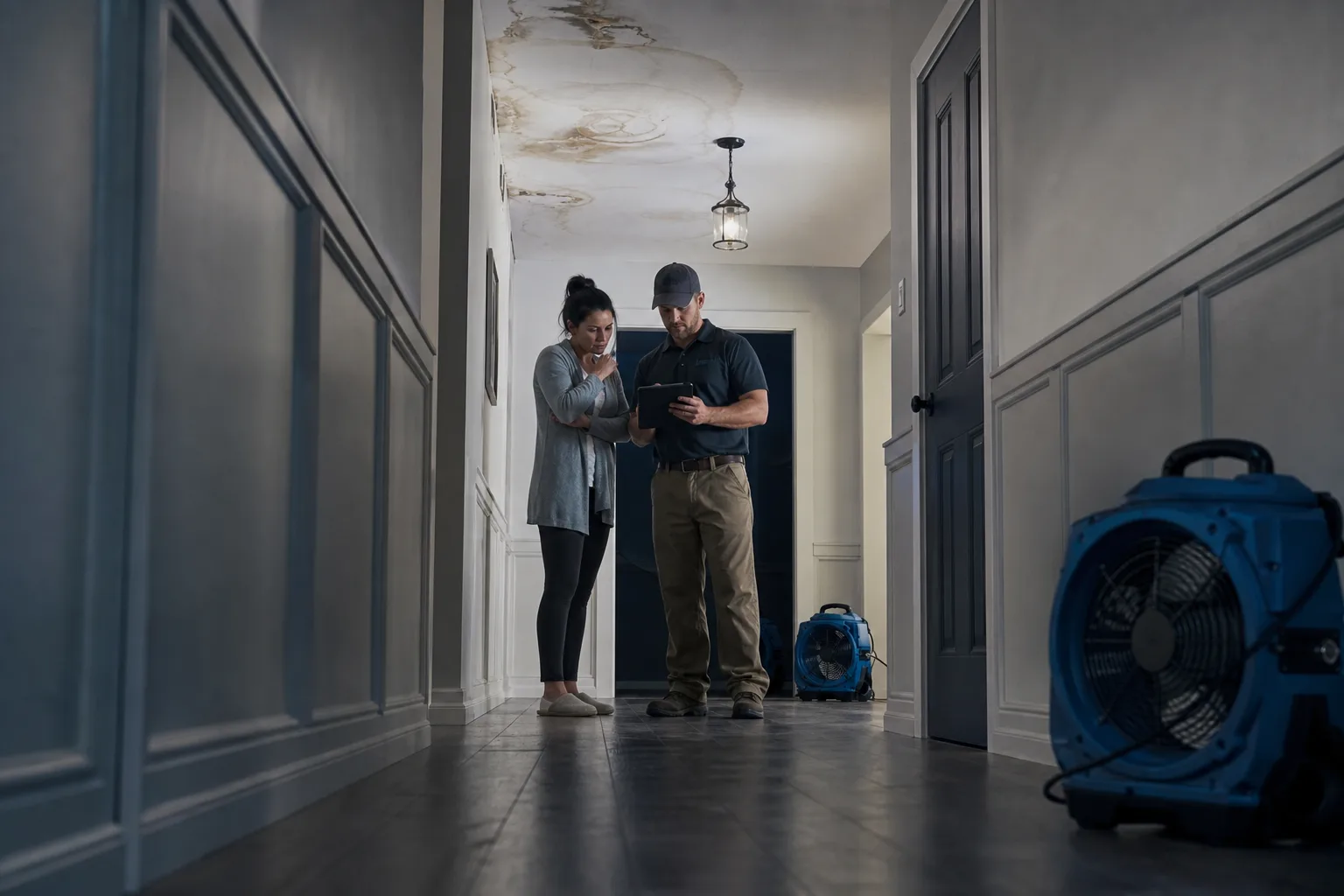
A washing machine supply line let go on the second floor of a split-level outside Kansas City on a Tuesday night, and by the time anyone noticed, water had found the ceiling of the room below and was coming through the light fixture. The homeowner shut the valve, called the number on a refrigerator magnet, and had a truck in the driveway before midnight. The technician was competent, polite, and holding a tablet with a two-page authorization on it. That form, signed at 11:40 at night by someone who had been mopping for an hour, did more to determine the next six weeks than the burst line did.
What the form at the door actually transfers
Emergency service authorizations vary, but most of them do three separate things that a tired reader tends to experience as one. They authorize the contractor to begin work, they set the basis for pricing (usually a published estimating schedule rather than a quoted number), and they direct the insurer to pay the contractor rather than the policyholder. The third of those is the one that moves control. Once payment is directed, the contractor has a financial relationship with the carrier that the homeowner is standing outside of, and disputes about scope start happening in conversations the homeowner is not part of. Some versions go further and assign the claim itself.
Whether that further step is even available depends on where the house is. Several states have written rules around assignment of post-loss benefits in property claims, and Florida has gone the furthest, restricting how assignments work, limiting what a contractor can commit an insurer to for emergency measures without the insurer's approval, and imposing notice requirements before suit. Other states leave the practice almost entirely to contract. The same tablet, the same company, the same wording, produces materially different consequences depending on the state line the truck crossed to get there. Asking which version you are being handed is a fair question at midnight.
The standard the crew works to is not a law
Most reputable water mitigation work in the United States follows the IICRC S500 standard, which sets out categories of water by contamination, classes of loss by how much material is wet, and the general expectation that structural materials be dried to a documented target rather than to whatever feels dry on a Thursday. Insurers reference it, adjusters expect it, and technicians are certified against it. It is an industry consensus standard, not a statute, and no state agency inspects a drying job for compliance. Its force comes from the contract and from the carrier's willingness to pay for work that follows it.
That distinction matters in the first forty-eight hours, because the practical decisions get made against the standard long before anyone is arguing about it. Category determination is the big one. Clean supply-line water becomes contaminated after contact with certain materials and after time, and the category drives whether carpet pad, drywall, and insulation come out or stay in. A crew that documents category, moisture readings, ambient conditions, and equipment placement daily has built the record that supports the invoice. A crew that does not has left the homeowner holding an argument they cannot win with photographs from a phone.
Where local rule takes over from national practice
Mold is the clearest example of geography deciding the job. The Environmental Protection Agency is responsible for federal guidance on indoor mold and moisture, and that guidance is advisory. Licensing is a state matter, and it is not uniform. Florida, Texas, Louisiana, and New York all license mold assessment or remediation as a distinct activity with its own credential, and several of them separate the person who assesses from the person who remediates, so the company that tells you there is a problem cannot be the company paid to fix it. Most states have no such requirement. In a licensed state, a mitigation contractor who starts cutting out visibly moldy drywall on day two without the right credential has created a compliance problem on top of a water problem.
Disposal is the quieter one. Extracted water has to go somewhere, and municipalities differ sharply on whether that somewhere may be a storm drain, a sanitary sewer cleanout, or a permitted disposal site, with sewage-contaminated water almost always restricted and sometimes reportable to a county health department. Demolition thresholds vary too. Pulling two feet of drywall in one jurisdiction is routine mitigation; in another, once the work touches electrical, plumbing, or a structural element, it is a permitted repair with an inspection attached. Coastal and flood-prone counties add substantial improvement rules that can convert a large repair into a compliance project.
The clock is not one clock
Homeowners tend to picture a single deadline sitting somewhere in the policy. In practice there are at least three running at once, and they belong to different parties. The policy imposes a duty on the insured to give prompt notice and to take reasonable steps to prevent further damage, which is the clause that makes fast mitigation a contractual obligation rather than a favor to the carrier. State insurance codes impose separate timelines on the insurer for acknowledging a claim, assigning an adjuster, and responding to a proof of loss, and those intervals differ by state, with catastrophe declarations sometimes extending them. And the physical clock, the one governing microbial growth in wet organic material, ignores both.
Knowing which clock belongs to whom changes what you push on. Slow adjuster contact is a regulated matter with a state insurance department behind it, and a written record of when you reported the loss is what makes that leverage usable. Scope disagreement is a contract matter between you and the contractor, resolved by having the mitigation scope in writing before equipment is set, including how many days of drying are anticipated and what triggers a change. Drying performance is a technical matter, resolved by daily moisture logs. Three problems, three routes, and mixing them up is how forty-eight hours turns into a stalled job.
Keeping the decision where it belongs
The homeowner in the split-level did one thing that paid for itself. Before signing, they crossed out the direct payment clause, initialed the change, and had the technician initial it too, then let the crew set fans at midnight as planned. Work started on time, the emergency was handled, and the money still ran through the policyholder. Every subsequent conversation about scope, category, and days of drying happened with all three parties in the room, because the party writing the checks had not been rearranged at the door. The carrier paid, the contractor was paid, and nobody had to litigate who had authorized what.
The rules that govern those first two days are real, but they are stacked rather than centralized: a private standard the industry follows, a state licensing regime that may or may not treat mold as its own trade, a municipal code that decides where the water goes and when a permit attaches, and a contract signed under pressure. Reading the last of those slowly is the one piece of the stack fully within your control, and it takes about six minutes.