Government
Nobody at the Counter Will Say Yes or No. Here Is Who Actually Decides
A two-foot setback encroachment, three vague answers from three city employees, and the split between staff approvals and board decisions that explains all of it.
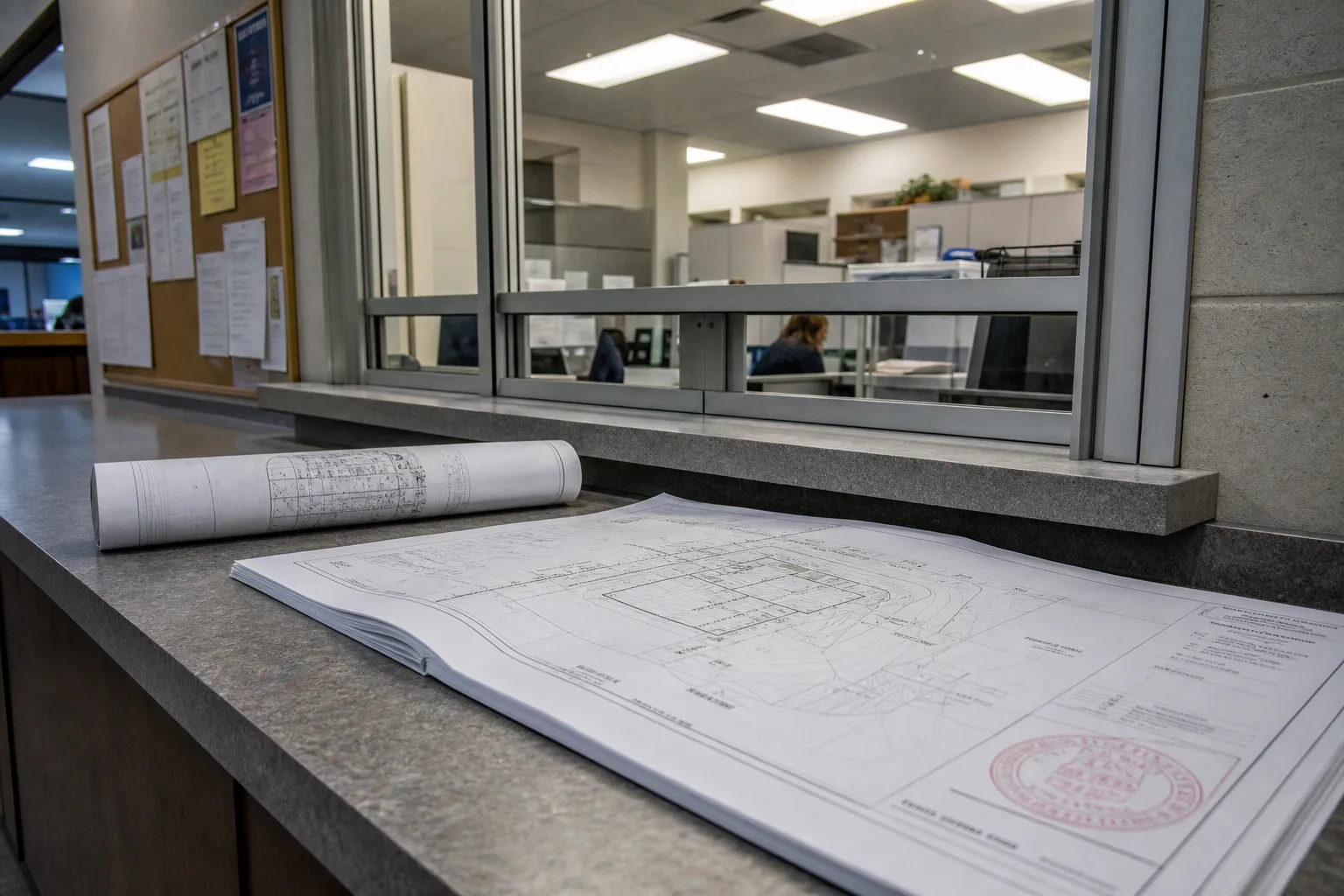
The addition was twelve feet deep across the back of a 1949 ranch, and it clipped the required side setback by roughly two feet at the northeast corner. The homeowner brought a survey, a contractor's site plan and a check to the permit counter. The plans examiner said he could not approve it. The building official said setbacks were not his department. The zoning administrator, reached by phone two days later, said the owner could submit and see what happened. Three employees, three answers, and not one of them was a decision. That pattern is not evasion. It is structure.
Three people who genuinely could not say yes
The plans examiner was telling the literal truth. His delegated authority runs to applications that comply with the ordinance as written, and this one did not, by two feet, in a way the survey documented in ink. The building official's remit is the construction code: framing, egress, fire separation, footings. Setbacks live in the zoning ordinance, a separate body of law with a separate administrator and a separate appeal path. The zoning administrator could have denied it outright, which is why she suggested submitting. A denial is not a dead end. It is the event that opens the door to the body that can grant relief.
How the two tracks came to exist
American zoning was assembled in the 1920s from a model statute circulated by the federal Commerce Department and adopted, with local variations, by state after state, then given constitutional cover by the Supreme Court in 1926. The model included a safety valve from the beginning: a board of adjustment, made up of appointed residents rather than staff, empowered to grant variances where strict application of the rules produced an unreasonable result. The design assumed most applications would be heard in public. Volume changed that. As permit counts grew through the postwar decades, cities pushed routine, rule-following approvals down to staff and reserved the board for everything else.
What the applicant meets today is the residue of that split. One track is administrative, ministerial, and fast, and the person handling it has no discretion at all, which is precisely why he cannot be argued with. The other track is discretionary, scheduled, noticed to neighbors, and decided by people who do not work for the city. Counter staff are often careful not to predict what a board will do, both because they cannot know and because a confident guess that turns out wrong becomes a grievance. The vagueness the customer experiences is the boundary between the two systems, felt from outside.
Reading the ordinance for the name of the decider
Nearly every zoning ordinance contains a table, usually early in the administration chapter, that lists each type of application beside the body that approves it and the body that hears an appeal. Some jurisdictions call it a summary of review authority. It is the single most useful page in the document for someone about to spend money, because it converts a fog of officials into a name. A setback variance goes to the board of adjustment or zoning board of appeals. A special use permit usually goes to the planning commission, sometimes with a city council confirmation. A rezoning goes to the elected body, always.
Overlays complicate the answer and should be checked before anything is filed. A property inside a mapped flood hazard area carries a second reviewer, the local floodplain administrator, working under standards tied to the National Flood Insurance Program that the Federal Emergency Management Agency oversees. A historic district adds a design review commission. A corridor overlay can add landscaping and frontage standards administered by yet another desk. Each of these is a separate decision with its own criteria, and a yes from one does not bind the others, which is why an owner who asks only the friendliest office gets a misleadingly clean answer.
What the board is actually allowed to consider
A variance is not a vote on whether the addition looks nice. State law and the local ordinance set out criteria, typically four or five, and the board is supposed to make written findings on each: that a physical condition of the lot creates a genuine hardship, that the condition was not created by the current owner, that the relief requested is the minimum necessary, and that granting it will not substantially injure neighboring property or the public interest. Testimony that does not touch those criteria is, formally, noise. The ranch owner's case was the lot itself, an irregular pie shape from a 1940s subdivision, narrowing toward the rear.
That framing changed what he submitted. Instead of a letter about needing a bigger kitchen, he filed a plat overlay showing that no rear addition of usable depth could be built within the setbacks, a photograph of the affected side yard, and a signed statement from the adjoining owner whose wall faced the encroachment. He also proposed his own condition: no windows on that elevation. Boards approve conditioned applications far more readily than open ones, because a condition gives them something to write into the findings, and an applicant who arrives with the condition already drafted controls its wording.
The clock that starts when the decision is signed
Discretionary decisions carry short appeal windows, commonly measured in days from the date the written decision is filed rather than from the date of the hearing or the date anyone tells the applicant. Missing it forecloses review by the courts entirely, whatever the merits. The same window runs the other way, so a neighbor unhappy with an approval has that period and no more. Anyone planning to order materials on the strength of an approval should count the window out on a calendar first, then confirm with the clerk which document started it and where the signed original sits.
The ranch addition was approved with the window condition attached, at a hearing that ran under fifteen minutes. What made it short was that the person presenting had stopped asking the three employees who could not decide and started writing to the seven who could.