Digital
Locked Out of a Portal on a Sunday? Who Actually Chose Your Password Rules
A homeowner locked out of an insurance portal at the worst possible hour, and the vendor decisions behind every password rule customers are told are their own responsibility.
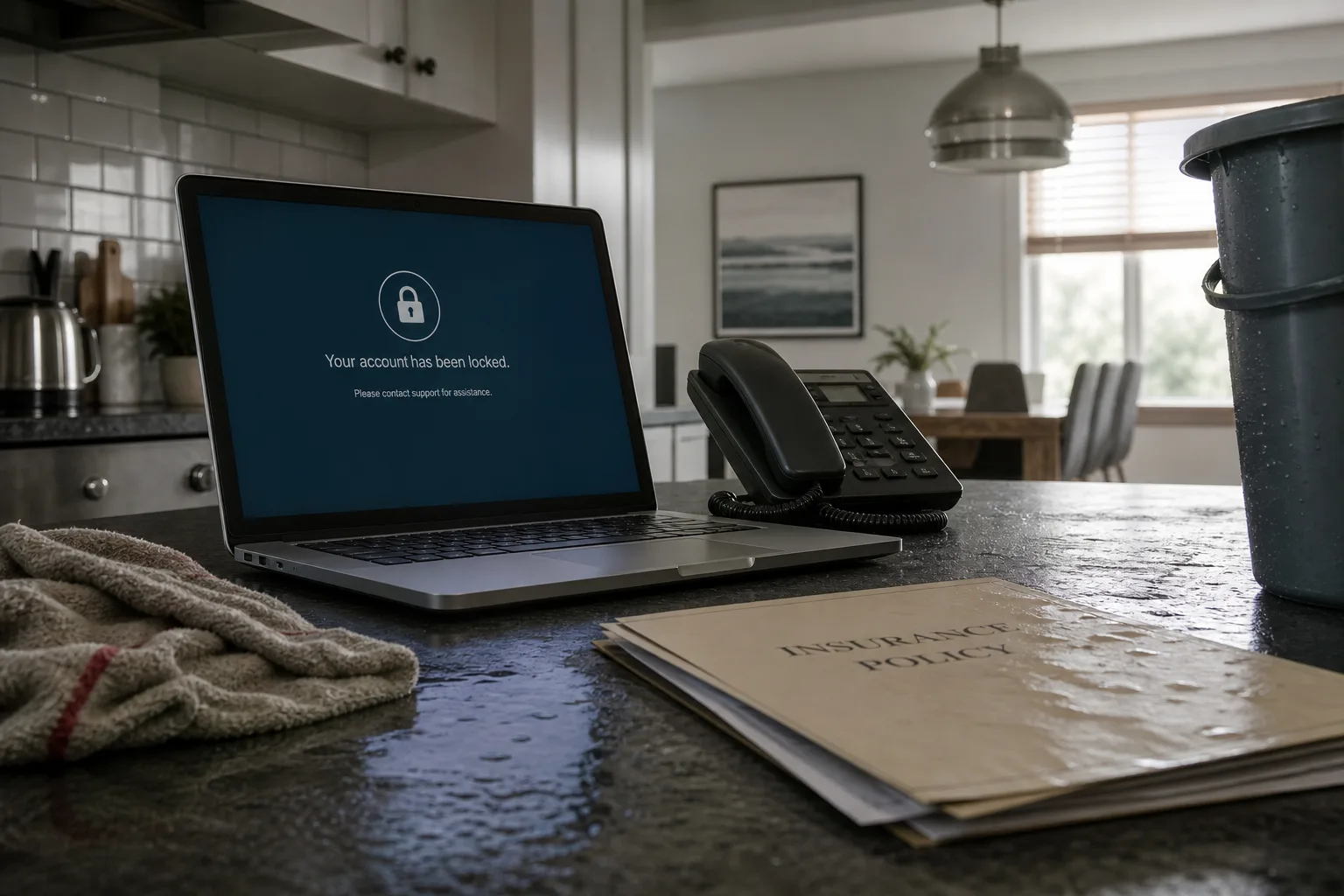
A homeowner in a suburb outside Columbus found water spreading across a finished basement on a Sunday morning, and did what the paperwork told her to do, which was to start the claim online. The insurer's portal rejected her password twice, then locked the account for fifteen minutes. The reset link went to an email address she had abandoned when she changed jobs in 2019. The verification code offered as an alternative was a text message, and the number on file was the landline she had kept for the alarm system. Every one of those dead ends was chosen by someone. None of them was chosen by her.
The lockout was a series of vendor decisions, not a user error
Trace the failure back and it decomposes into four separate choices made inside the insurer's systems, most of them years before the pipe split. Somebody set the lockout threshold at three attempts rather than ten. Somebody decided password recovery would run through the email of record rather than through the mailing address, the policy number, or a callback. Somebody built the code delivery on SMS only, with no voice option, which quietly excluded every customer whose number was a landline. Somebody else decided the portal would not surface which email it was writing to, so she spent twenty minutes guessing. The customer was addressed at every step as the responsible party. She held none of the levers.
She got in eventually, by calling the claims line and answering questions about her deductible and her mortgage servicer, which is its own form of authentication and a fairly weak one. The claim was filed that afternoon and paid without dispute. The point is not that the system failed permanently. It is that the recovery path that worked was staffed, expensive, and available only during a phone queue, while the recovery path that was designed for her did not fit the facts of her account.
Composition rules push customers toward predictable behavior
The rules a site imposes at signup are the clearest example of a decision made by one party and paid for by another. A site that demands an uppercase letter, a digit, and a symbol, and caps the length at sixteen characters, has not made its customers safer. It has made them append an exclamation point and a year to a word they already use elsewhere, because that is the cheapest way for a human to satisfy an arbitrary shape. Length caps are the most telling signal, since a well-built system stores a fixed-size hash and does not care whether the input is twelve characters or ninety. A cap usually means something old is sitting behind the login form.
Customers notice the consequences long after the fact and rarely connect them. The password you invented to satisfy one bank's symbol requirement gets reused at a retailer, the retailer is breached, and credential stuffing does the rest. What looks like careless reuse is often the residue of a dozen incompatible rule sets, each of which forced a small mutation on a memorable base. The National Institute of Standards and Technology maintains the digital identity guidance that federal agencies work from, and the direction of that guidance has moved firmly toward length, screening new passwords against known breached lists, and dropping the composition theater. Sites that have adopted it feel different to use, and most customers register that only as a vague sense that the signup was easier.
Recovery is the real password, and you did not choose it
Whatever you type into the login box matters less than the channel that can replace it. If a reset link to your email address grants entry, then your email password is your bank password, your insurance password, and your utility password all at once. That consolidation was never presented to you as a decision. It arrived one service at a time, each one reasonably assuming email was a stable identifier, until a single mailbox became the master key to a household's financial life. The practical consequence is that the account most worth protecting with a long unique passphrase and a hardware or app-based second factor is usually the one people treat as ordinary.
Security questions sit in the same category and age worse. A mother's maiden name and a first street are not secrets, they are public records with a permanent shelf life, and unlike a password you cannot rotate the town you grew up in. Where a site insists on them, the workable answer is to treat the field as a second password, enter a random string, and store it wherever you store the first one. That is a customer-side workaround for a vendor-side design, which describes most of what competent personal security actually consists of.
What is genuinely in the customer's hands
Three things, reliably. The recovery contact details on every account that touches money, which should be current, should include a voice-capable number where the option exists, and are worth a single afternoon to audit. The email account underneath all of it, which deserves the strongest credential in the household and a second factor that is not a text message. And the choice, where a service offers it, to enroll a passkey, which moves the secret onto a device and out of the class of things that can be phished, reused, or typed into a convincing copy of a login page.
The rest is being decided for you, in a product meeting you will never attend. Knowing which part is which is the difference between a Sunday morning spent on hold and a claim filed in ten minutes.