Finance
Grills Gone From the Balconies? The Insurance Paragraph That Wrote the House Rules
Exclusion clauses rarely ban anything outright, yet they end up written into leases, waivers and posted notices by organizations that had less choice than they appear to.
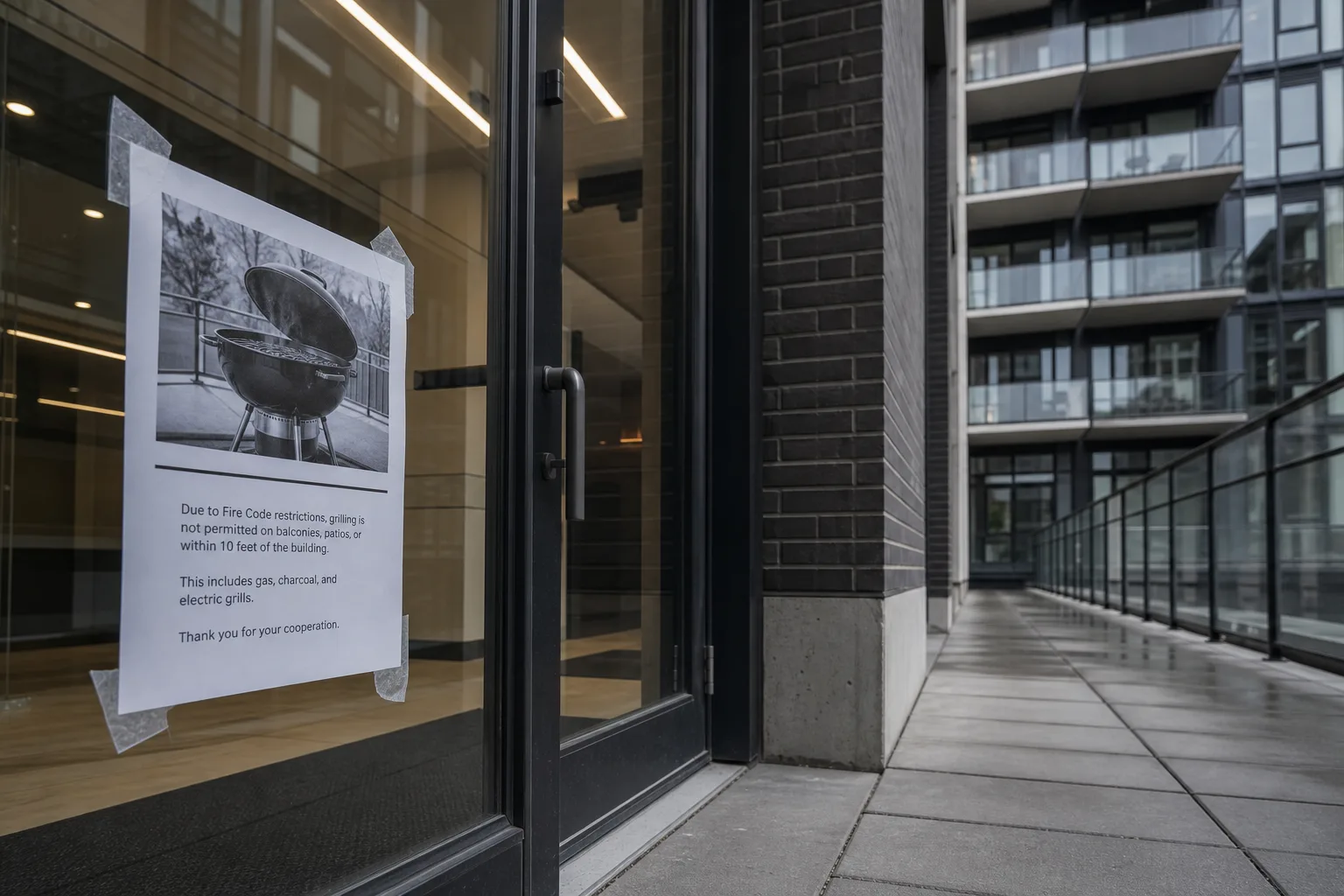
A management company running roughly forty apartment communities sends the same notice to every resident in the same week: no charcoal or propane grills on balconies or within fifteen feet of the building, effective at the start of next month, with a fine schedule attached for a second violation. Residents who have grilled on those balconies for six years ask the on-site manager what changed, and the answer they get is that it is policy now. That answer is accurate and almost useless. The change did not originate on site, it did not originate with the regional office, and the person delivering it could not have prevented it.
The notice said policy, and it was telling the truth
Trace the paper backward and the trail runs through a broker to a general liability renewal, where the carrier attached an endorsement excluding loss arising from open flame or portable cooking appliances used on elevated exterior structures. The endorsement did not say residents may not grill. It said the policy would not respond if a grill caused a fire. The management company then faced a straightforward arithmetic problem: an uninsured fire in a wood-frame three-story building is a solvency event, not a claim, and the only lever available was the lease. So the exclusion became a rule, the rule became a notice, and the notice became a fine schedule.
That conversion happens constantly and is almost never visible from the receiving end. The diving board that disappeared from the community pool, the church basement no longer available to the scout troop on weeknights, the day care that stopped taking children under eighteen months, the gym that closed its sauna, the moving company that will no longer disassemble a crib: each of those is frequently the downstream form of a paragraph in a policy nobody outside the risk department has read. The organization is not being arbitrary. It is being precise about a liability it can no longer transfer.
An exclusion does not forbid anything, it declines to pay
This distinction matters because people argue with the wrong thing. An exclusion is a statement about the insurer's obligation, not about your conduct, and there is no law anywhere that says a resident cannot cook outdoors. What the exclusion does is move a specific category of loss from the carrier's balance sheet back onto the policyholder's, and the policyholder is the organization, not you. Once that move happens, the organization has three options: absorb the risk, buy the coverage back at a price, or eliminate the activity. Elimination is the cheapest of the three and requires no underwriter's approval, which is why it wins.
Buying it back is the option most people do not know exists. Carriers frequently price a coverage buyback, a sublimit, or a separate endorsement for exactly the excluded activity, and organizations sometimes decline it after comparing the annual premium to the revenue the activity generates. A pool with a diving board may cost several thousand dollars a year in additional premium and produce nothing measurable in leasing. A climbing wall at a gym may pay for its own endorsement twice over. The exclusion sets the question. Someone inside the organization answers it, and that answer is a business judgment, not a legal necessity.
The choice sits several doors above the person explaining it
The on-site manager holds no part of this. Neither, usually, does the regional director, whose authority typically covers staffing, pricing and vendor selection but not the terms of a master policy negotiated at the corporate level for the whole portfolio. The people with actual discretion are the risk manager who instructs the broker, the broker who markets the account to carriers, and the underwriter who decides what to attach at what price. In a large organization that chain may include a captive insurer, a self-insured retention of a quarter million dollars per occurrence, and a reinsurance treaty whose terms constrain the carrier in ways the carrier does not explain to the insured.
The practical consequence is that escalating one level rarely helps. A resident who pushes the leasing office gets a sympathetic shrug, and a customer who asks a franchise location why it no longer does something gets a manager repeating a directive. The party who can revisit the decision is the one who signed the renewal, and that person responds to portfolio-level arguments: this activity retains tenants, this exclusion is priced at a figure we can absorb, this competitor down the road has the coverage and we do not. Individual complaints do not reach that desk. Aggregated ones sometimes do, particularly during the sixty days before a renewal.
Where the excluded risk actually lands
Removing an activity does not remove the exposure, it relocates it. A resident who grills in the parking lot instead of the balcony has moved the fire, not extinguished the possibility of one, and now the question of who pays turns on that resident's own renters policy and its liability limit, commonly a hundred thousand dollars and frequently far short of a building loss. Landlords increasingly close that gap by requiring proof of renters coverage at a stated limit and naming the ownership entity as an additional interest, which is another downstream artifact of the same endorsement. The lease clause and the policy clause are the same decision wearing different clothes.
Flood is the clearest example of the pattern, because the exclusion is nearly universal in property policies and the substitute is a separate government-backed program. The Federal Emergency Management Agency administers the National Flood Insurance Program, and a great deal of what building owners require of tenants, ground-floor storage rules, elevation of equipment, restrictions on finished basement space, descends from the fact that surface water is carved out of the main policy and has to be covered somewhere else or not at all. Once you know the carve-out exists, the building's odd rules stop looking odd.
How to find the party who can still say yes
Ask for the source rather than the rule. A written request to a property manager or a regional office asking which policy provision or underwriting requirement the restriction implements will usually produce either a citation or an admission that there is not one, and both are useful. If there is a citation, the follow-up question is whether a buyback or endorsement was quoted and declined, and at what price. If there is no citation, the restriction is discretionary and the person in front of you may actually be able to change it. Timing matters too, since renewal dates are the only moments the terms are genuinely open.
Read your own policy against the organization's rules while you are at it. Where a landlord, employer, club or vendor has pushed an excluded risk onto you, the sensible response is to know your own limit, raise it if it is thin, and consider an umbrella policy, which is inexpensive relative to the exposure it covers. The rules posted on the wall are the visible end of a negotiation you were not party to. Knowing where the paragraph came from tells you which door to knock on, and how much time you have before it closes.