Housing
Called the Number on the Insurer's App? Who Shows Up and Who Owns the Scope
A burst supply line, a national dispatch center, and a franchise crew ninety minutes out: the four people whose work sits next to yours in the first two days.
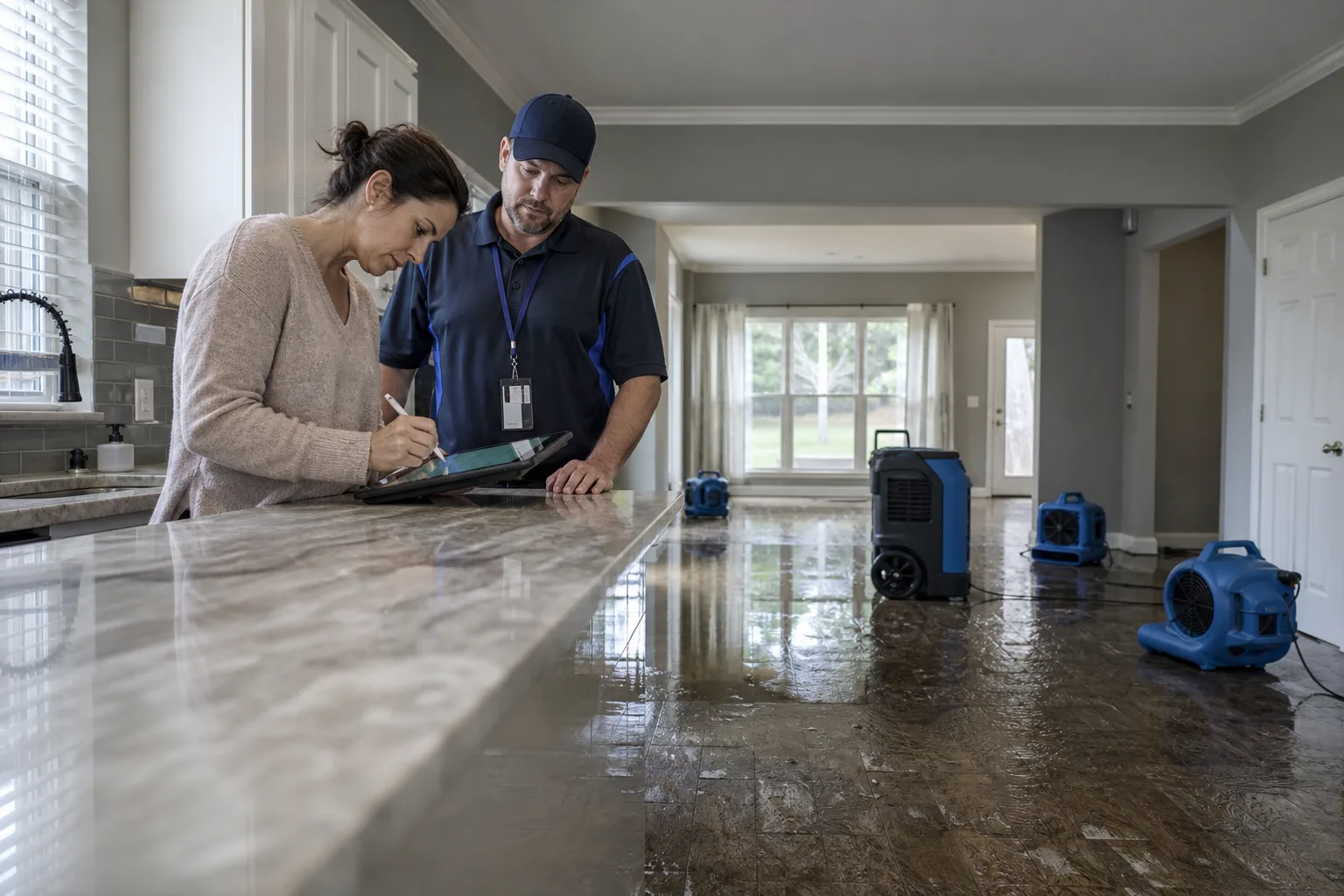
The braided supply line under the upstairs vanity let go on a Saturday at some point before seven in the morning, and the homeowner found it at eight when the kitchen ceiling started weeping at a light fixture. She did what the paperwork told her to do: opened the insurer's app, tapped the button marked emergency water mitigation, and spoke to a person who was pleasant, thorough, and roughly nine hundred miles away. A crew arrived at eleven-forty. Three weeks later the argument was about how many drying days had been billed, and nobody could agree who had authorized the fourth one.
The person on the phone is not the person with the truck
The number in the app routed to a managed repair network, a company the insurer contracts with to dispatch, monitor, and price mitigation work across dozens of states. That call center takes the loss details, assigns a job number, and pushes the job to a participating contractor by geography and availability. The homeowner assumed she had hired the brand she saw on the van. What she had actually done was trigger an assignment to an independently owned franchise operating under that brand, sixty miles out, with its own payroll, its own equipment inventory, and its own reading of how long a plaster ceiling takes to dry.
None of that is hidden, and none of it is a problem by itself. The network exists because insurers want a consistent scope and a documented moisture log rather than forty different invoice formats. But it means the first two questions worth asking on that call are simple ones: what is the name of the company being dispatched, and what is the direct number for the person who will run the job. The dispatcher can answer both. Once the crew is on your floor, the call center is no longer the party you negotiate with.
The work authorization is a contract, and it names four parties
The lead technician handed over a tablet at the kitchen counter, and the homeowner signed while water was still coming through the ceiling, which is when almost everyone signs. That document did three separate things. It authorized emergency services, it set the rate structure, usually by reference to the pricing database the industry and most carriers use rather than to a flat quote, and it contained a direction to pay, assigning claim proceeds for mitigation directly to the contractor. The insurer is not a party to the contract. The homeowner is, personally, for whatever the carrier declines.
Working backwards from the billing fight, that signature was not the mistake. The mistake was that nobody wrote down the scope in the ten minutes before it. Two sentences in the notes field would have carried the whole thing: which rooms, how many air movers, and the agreement that any extension past the initial drying period gets a text to the homeowner first. Larger providers accommodate that easily, because their project managers already document daily. Ask for the note. Photograph the signed page. The people who deal with these contracts every week are not surprised by the request.
The adjuster you speak to is probably not the adjuster who decides
By Monday morning there were three insurance-side people attached to the loss. A desk adjuster, working a queue from a service center, owned the file and the coverage decision. A field adjuster, in this case an independent contractor deployed through a third-party administrator because the storm season had thinned the carrier's own staff, came out Tuesday to scope the repair. Behind both sat the network's own audit function, which reviews the mitigation invoice against the carrier's guidelines before it ever reaches the desk adjuster's screen. Three reviewers, three different mandates, one file.
This matters on day two rather than day thirty. The field adjuster's scope becomes the reconstruction estimate, and the mitigation invoice is audited separately against drying standards. If the ceiling has already been cut out by the time the field adjuster arrives, which it should be, the only evidence of what was there is the crew's photographs and moisture readings. So the homeowner's job in the first forty-eight hours is not to argue coverage with anyone. It is to make sure the documentation the adjusters will read is complete, and to take her own set alongside it.
The trades that do not come with the mitigation crew
Mitigation firms dry buildings. They do not, as a rule, repair the thing that broke. The supply line was capped by a plumber the homeowner found herself on Saturday afternoon, and his invoice, paid out of pocket, turned out to be the single most useful document in the file, because it established the cause of loss as a sudden failure rather than long-term seepage. Keep it. The same separation applies to the electrician who checks the fixture the water ran through, and to the roofer or the sewer contractor when the source sits outside the walls.
Mold sits in its own lane. The Environmental Protection Agency is responsible for federal guidance on indoor mold and moisture, and the operating principle it reflects is that fast, thorough drying prevents the problem that remediation later has to solve. A large provider will usually have remediation certification in house and can escalate without a second procurement, which is a real advantage of the network model. Smaller firms subcontract it. Either is fine, as long as somebody tells you which one you are getting before the equipment goes in.
What the second call should sound like
By Tuesday the homeowner had the franchise owner's cell number, the project manager's daily moisture log emailed each evening, and a written note that equipment would not run past Friday without a text. The fourth drying day still got billed. It also got approved in about four minutes, because the log showed the subfloor reading and the text showed she had agreed to it.
The structure around a water loss is larger than the two people standing in your hallway, and most of it is reachable by phone if you know which seat you are calling.