Health
Twelve Visits Quoted, Nineteen Billed. What Actually Sets the Price of a Course of Treatment
A first physical therapy course quoted at twelve visits ended at nineteen, and the reasons were all visible before the first appointment.
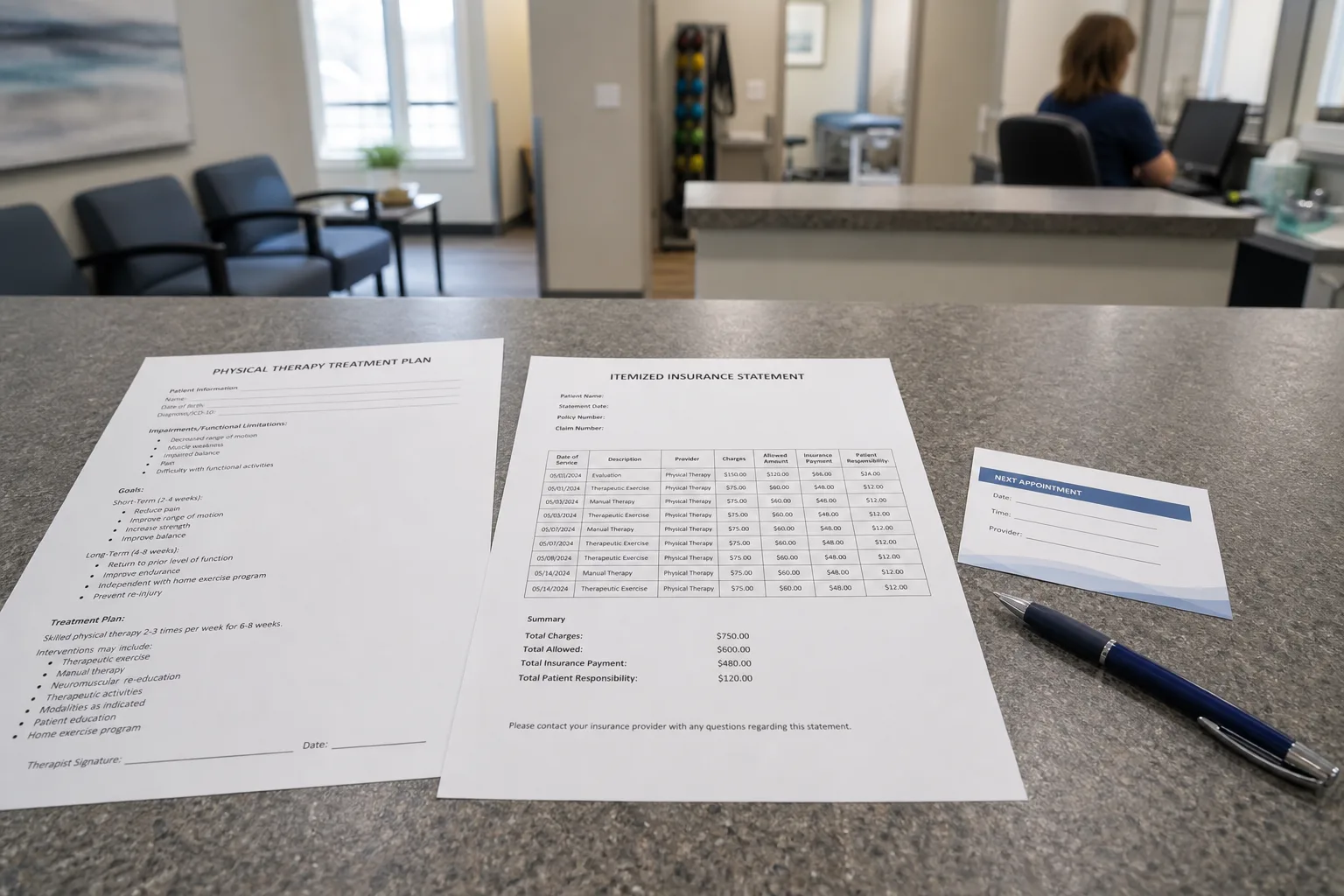
The front desk wrote it on the back of an appointment card: about twelve visits, twice a week, copay of thirty dollars. For a first-time physical therapy patient with a shoulder that would not lift above the shoulder line, that arithmetic was easy to carry home and easy to plan around. The final tally was nineteen visits and a balance that arrived in March, months after discharge, on a statement that used codes rather than sentences. Nothing improper happened. Every element of the difference was knowable at the outset, and most of it was written down somewhere the patient had not yet learned to look.
Working backwards from the statement
The March statement broke into three pieces once someone at the clinic walked through it line by line. Seven visits beyond the estimate, billed at the same rate as the first twelve. A deductible that reset on January 1, midway through the course, which meant visits in the second half were paid in full by the patient until that reset amount was met. And an evaluation charge on day one that was coded at a higher complexity tier than the patient assumed, because the shoulder had a prior injury, two comorbidities on the intake form, and a movement exam that produced an unstable result. None of those three was a surprise to the clinic. All three were a surprise to the patient.
A visit is not a unit of price
The thing that most often breaks a first-timer's estimate is the assumption that a visit has a price. In most outpatient rehabilitation, it does not. Timed services are billed in fifteen-minute increments, so a session that runs forty-five minutes of hands-on manual therapy and supervised exercise generates more billable units than a thirty-minute session that ends with heat and a home program. A patient on a flat copay never feels this. A patient on coinsurance, paying a percentage of the allowed amount, feels every extra unit. The same clinic, the same therapist, and the same diagnosis can produce visits that differ by fifty percent in cost, and the variable is how long the therapist's hands were on you.
This has a consequence people rarely trace back. Cancelling and rescheduling changes the shape of a course, because a therapist who has not seen you in eleven days spends the next session re-testing rather than progressing, and re-testing is billable time that buys no ground. So does skipping the home program. The clinic will not say this to you in cost terms, since its job is the shoulder, but the patient who does the four exercises on the printed sheet usually reaches discharge criteria in fewer visits. Adherence is a clinical instruction and a pricing lever at the same time.
The calendar moves the total more than the diagnosis does
A course that begins in October and ends in February crosses a plan year, and everything that resets on January 1 resets in the middle of your treatment: the deductible, the out-of-pocket maximum you may have already satisfied, and in many plans the authorized visit count. Patients who start in February and finish in April almost never see this. Patients who start in November see it as an unexplained doubling of their share partway through, which reads like a billing error and is not one. The fix is unglamorous and effective. Ask, before the first appointment, when the plan year turns over, and ask whether the course can be front-loaded or held two weeks so that it sits inside one year.
Authorization runs on its own calendar. Many plans approve a block of visits, say eight, after which the clinic submits progress notes and requests more. That request can be granted in full, granted partially, or denied, and treatment already delivered while the request was pending is still treatment you owe for. Knowing the size of your first block tells you where the second decision point sits.
What to ask before the first appointment
Ask for the estimate in codes, not in visits: the evaluation code the clinic expects to use, the treatment codes it typically bills for your condition, and the average number of units per session for a patient like you. Ask whether your benefit is a copay or coinsurance, because that single answer decides whether session length matters to you financially. Ask the clinic to run a benefits verification and to tell you the allowed amount, not the list price. Then ask what discharge looks like in measurable terms, since a course with a defined endpoint is a course you can budget. Clinics answer all of this readily when asked in advance. The Consumer Financial Protection Bureau oversees how medical balances are collected and reported once they go unpaid, which is a strong reason to settle the arithmetic while you are still standing at the desk.
The patient with the shoulder finished at full overhead range and paid roughly sixty percent more than the card said. The second course, two years later for a knee, was quoted in units, verified against the plan year, and landed within eighty dollars of the estimate.