Family
Ordering a Marker Through the Funeral Home? Who Is Paid at Each Step, and What Locks First
A granite marker passes through a quarry, a fabricator, a retail seller and a cemetery crew, and each one earns differently. Here is where the money sits and which signature is final.
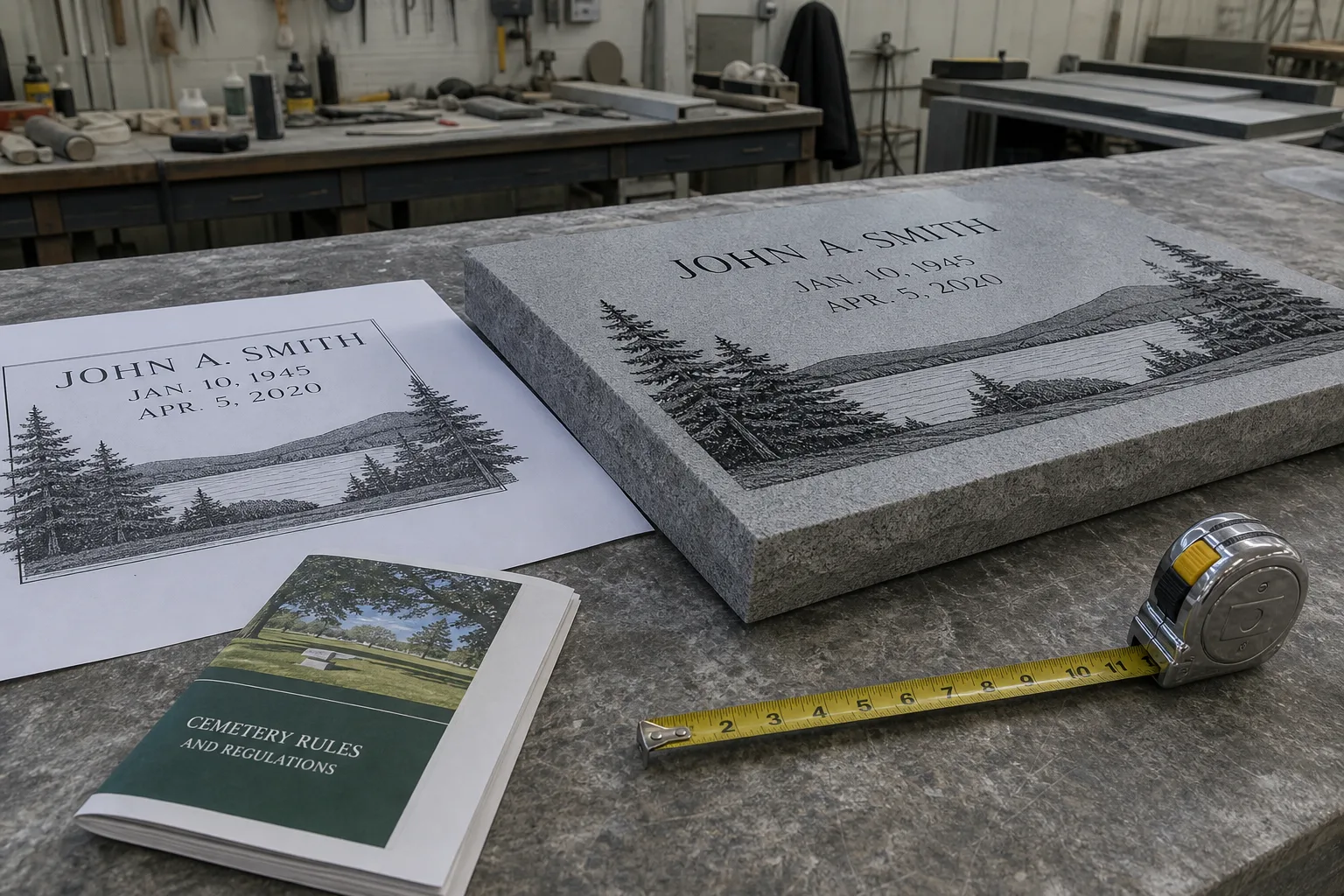
A family arranging a burial in a suburban county cemetery was handed two pieces of paper on the same afternoon. The first was the funeral home's itemized statement, with a line for a flat granite marker at a single price, installed. The second came from the cemetery office two days later: a foundation charge, a setting fee, and a note that markers in that section may not exceed twenty-four inches by twelve inches, in gray or rose granite only. Nobody had misled anyone. But the marker on the first sheet had been quoted before anyone read the second, and the granite the family liked was not permitted in the section they had already bought.
That sequence, rather than any one price, is what shapes most memorial decisions now. The marker is a manufactured object that passes through four hands before it sits on a grave, and each pair of hands earns money in a different way, on a different schedule, with a different amount of discretion about what you are told. Following that chain is more useful than comparing catalog photographs, because the catalog is usually the last link, the one closest to the family and the one with the least control over what is actually allowed.
Four hands, four ways of getting paid
Granite is quarried in a small number of places and sold in blocks to fabricating plants, which saw, polish, shape and letter it. Those plants historically sold wholesale to retail monument dealers, the family firms that clustered along the road outside cemetery gates, and the dealer's margin covered showroom space, design help, and the crew that poured the foundation and set the stone. The retailer carried the risk of a misspelled name and the cost of correcting it. That arrangement lasted for generations, and it explains why memorial pricing still looks like furniture pricing: one delivered number, with the components folded inside it.
What has been rearranged in the last two decades is who occupies the retail slot. Funeral homes, which for most of the twentieth century sold caskets and services and left stones to the monument trade, now commonly sell memorials as well, sometimes through a wholesale account with a fabricator and sometimes as an agent earning a commission on a dealer's order. Cemeteries, especially those owned by regional operators, do the same, and some also charge an additional fee when a marker arrives from an outside seller. Online sellers ship finished stones to a local installer. All four routes reach the same quarry.
What cremation changed, and what changed because of it
The shift that reorganized the memorial trade was not a change in taste in stone. It was cremation becoming the majority choice in most of the country, which cut the average revenue per funeral, removed the casket from many transactions, and left providers looking for goods that families still wanted and would still pay for. Memorials qualified. So did niches, benches, boulders with bronze plaques, scattering gardens with a name wall, and companion markers designed to receive a second inscription years later. Cemeteries responded by platting new sections with different rules from the old ones, which is why two areas of the same grounds can permit entirely different objects.
The other recent change is technical, and it has quietly moved the point of no return earlier in the process. Lettering was once laid out by hand, chalked and rubbed, checked in person, and cut by an operator who saw the name. Layout is now digital, sandblast stencils are cut from a file, and laser etching can put a photograph, a signature or a line of handwriting into polished granite. The family approves a proof on a screen or a printed sheet, and the file goes to production. That has made unusual inscriptions affordable and fast. It has also made the proof, not the finished stone, the last moment anyone reads the name.
The decisions that hold, and the ones that only look final
Three choices are effectively permanent. The inscription is the obvious one: cut granite cannot be uncut, and a correction means a new stone or a visible patch. Second is the foundation, because it is poured to the footprint of the memorial you ordered, and a wider stone later means new concrete and a new setting charge. Third is the section and the plot, since the rules attached to them govern size, material, color, finish, upright versus flat, and whether a vase, a photograph or a bench is allowed at all. Reversing the third choice means moving a burial, which is a different order of undertaking.
Several things that feel irreversible are not. A blank date field for a surviving spouse can be cut later, on site, by a competent letterer, and planning for that is routine. Bronze plaques on niche fronts are replaceable, which is one reason columbarium lettering is often held to a house standard: the cemetery expects to reset that face. Vases, ledgers and secondary inscriptions are frequently added years afterward. The practical rule is that anything cut into the stone's face at the plant is final, and anything attached to it, or added on site, can usually be revised for a fee that someone will quote you in writing.
Ask who is paid by whom before you ask the price
The single question that clarifies a memorial quote is who receives money from whom on this order. If the funeral director is selling the stone, ask whether the firm buys it wholesale and resells it or earns a commission from a dealer, and ask for the fabricator's name. If the cemetery is selling it, ask the same, and ask separately what the cemetery charges when a marker is bought elsewhere, since that figure is the real comparison against an outside price. If a cemetery keeps a list of approved dealers, ask what approval required. None of these answers is disqualifying. They tell you which recommendations are advice and which are inventory.
Federal disclosure practice helps here, though only on one side of the fence. The Federal Trade Commission is responsible for the rules requiring funeral providers to give itemized price information and to accept goods a family bought elsewhere, and that framework is why the funeral home's statement breaks out lines at all. Cemeteries and monument dealers sit differently within it. So the itemization that arrives automatically from one party has to be requested from the other, and the request is ordinary: foundation, setting, permit or recording fee, outside-marker handling, sales tax, and the stone itself, each on its own line.
The order that keeps the choice open
Read the section rules before choosing a stone, get the cemetery's fee schedule in writing before comparing sellers, then choose the memorial, then approve the proof with two people reading the inscription aloud against a document that spells the names, dates and any inscription text exactly as it should appear. Run in that order and every question that has one correct answer gets answered by the party who actually controls it. That is what the trade's rearrangement has made possible: the pieces are now priced separately enough that a family can see each one and decide it deliberately.
The stone is the only part of a funeral that is still there in thirty years. Spending an extra week on it, with the rulebook and the fee schedule on the table, is the cheapest week in the whole process.