Family
Frozen Ground and a Closed Registrar's Office. The First Week of a Winter Funeral, in Order
A late-December death in a cold-weather county shows which paperwork moves the week forward, and which party actually holds each decision.
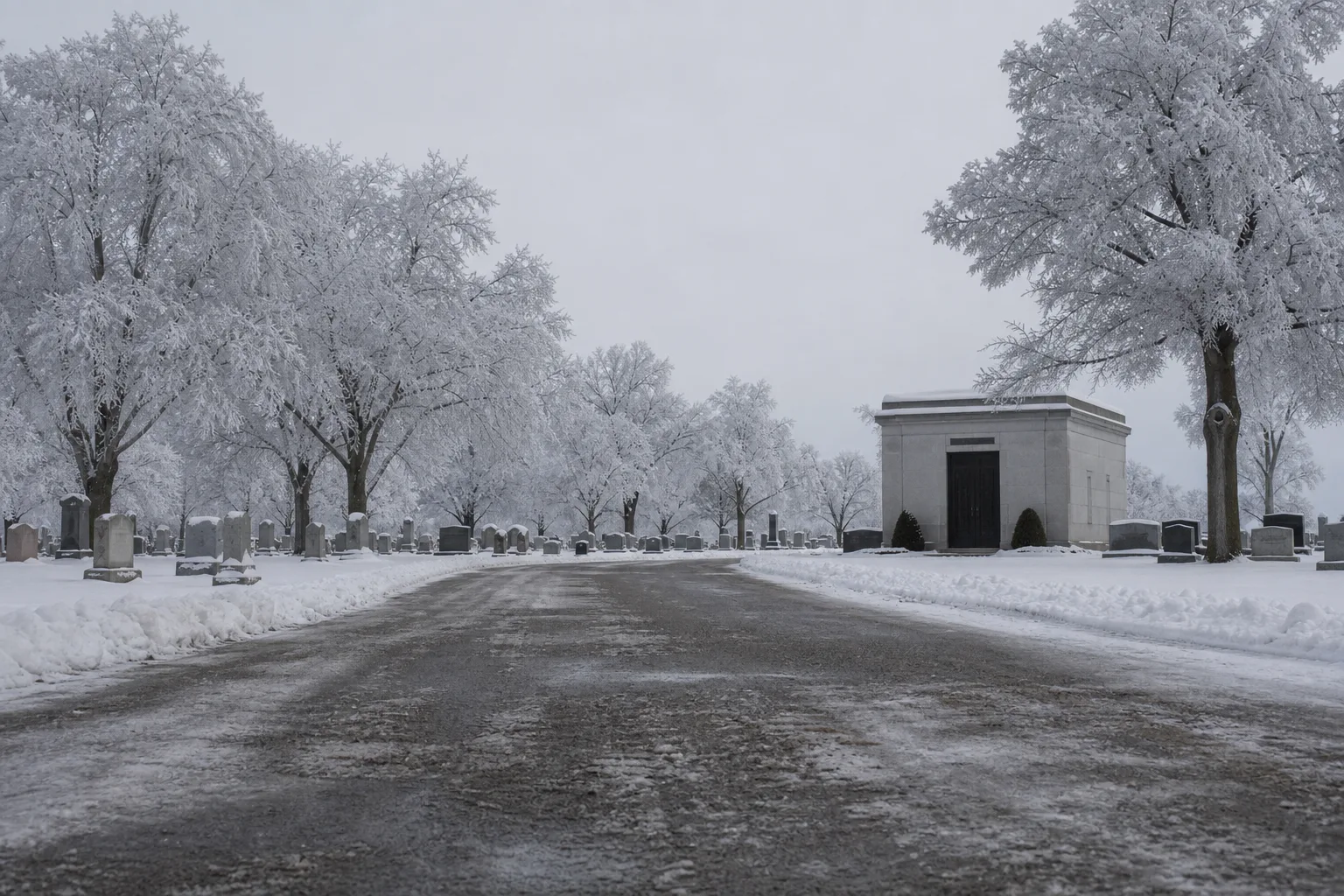
A woman dies at home in a small city in upstate New York on the evening of December 22. Her daughter, the only surviving child, lives in Tucson and is on a plane the next morning. By the time she reaches the funeral home on the afternoon of the 23rd, she has been asked for four decisions and can answer two of them. The other two are not hers, though nobody has said so plainly. What follows is that week in the order it actually happened, and the short stack of documents that carried it, because in a winter arrangement the calendar removes options that a July death would have left open.
Day one: the signature nobody in the family can supply
Nothing in the week moves until the medical certification of death is signed. In most states that is the attending physician, a hospice medical director, or the coroner or medical examiner if the death is unattended or unexplained. The funeral home cannot sign it, and the family cannot hurry it beyond asking clearly and often. In this case the attending physician was out of the office from the 23rd through the 26th, which meant the certification sat unsigned for three days while everything downstream waited. The practical tool here is a single question, asked on the first call: who is signing, and is that person working this week.
Ask it of the hospice nurse, the hospital nursing supervisor, or the funeral director, and get a name. A partner in the practice can often certify in place of a colleague who is away, but only if someone requests it. That request is the first genuinely useful thing a family member can do in a holiday week, and it belongs to whoever is willing to make the phone call rather than to the person who happens to be listed as next of kin.
Who is the authorizing agent, and why the same person keeps being asked
The funeral home returned to the daughter for every authorization, not out of habit but because state law sets an order of priority for the person entitled to control disposition. A surviving spouse first, then adult children, then parents, then siblings, and so on down a statutory list. Where there is a written designation of an agent for disposition, that document outranks the list entirely. The daughter signed three separate forms on the 23rd: authorization for removal and embalming or refrigeration, authorization for cremation with the identification and pacemaker disclosures attached, and the funeral home's own contract. Each of those signatures is a decision she owned, and each of them is difficult or impossible to reverse once the next step begins.
Her cousin, who lived nearby and had done most of the caregiving, held no authority at all in the eyes of the crematory. That surprised both of them. It also explains a pattern families notice and resent, which is that the funeral home appears to ignore the person most involved. It is not ignoring anyone. It is protecting itself against a claim from the person the statute names, and the way to make the caregiving cousin useful is to have the authorizing agent put her in writing as the point of contact, which most firms will accept in a sentence added to the file.
Day four: what the cemetery rulebook decided instead of the family
The plan had been burial in the family plot beside her husband. The cemetery office, reached on the 27th, said what cold-weather cemeteries generally say in late December: the grave could be opened, at a winter charge, or the casket could be held in the receiving vault until the spring thaw and a committal scheduled in April. That is a cemetery policy, written in its rules and regulations, not a preference the funeral home imposed. The document that governed it was the deed to the plot, which named the deceased and her husband, and the interment right recorded against it.
Two pieces of paper settled the question. The first was the plot deed, found in a folder of insurance papers, which established that the right of interment existed and who held it. The second was the cemetery's signed interment order, which specifies the grave, the depth, the liner or vault requirement and the date. The family chose the spring committal, held a memorial service on the 29th while relatives were already in town, and paid the opening charge four months later at the standard rate. Splitting the service from the burial is common in winter counties and costs nothing extra beyond a second gathering.
The permits and copies that carry the rest of the year
Once the physician signed on the 26th, the funeral director filed the death record electronically with the local registrar and obtained the disposition permit, called a burial transit permit in many states, which is what legally allows cremation, burial or transport across state lines. Only after that permit issues can a crematory operate, and many states add a waiting period of twenty-four to forty-eight hours after death independent of the paperwork. The registrar's office was closed on the 25th and 26th, which absorbed another day. None of this is negotiable, and knowing the sequence is what keeps a family from believing the funeral home is stalling.
Then come the certified copies of the death certificate, which are the working currency of the following six months. Life insurance carriers, the Social Security Administration, banks holding accounts in the decedent's name, brokerage transfer agents, the DMV for a titled vehicle, and the county for a deed transfer each want an original certified copy, and some will not return it. The daughter ordered eight, used six, and was glad she had not ordered three. Order more than feels reasonable, because reordering later means dealing with the state vital records office rather than a funeral director who is already filing on your behalf.
The holiday calendar as a scheduling authority
Clergy availability, not the funeral home's book, set the date of the memorial. Between Christmas Eve and New Year's Day, church calendars are full and pastors are frequently traveling, so the parish office holds a decision the family assumes is theirs. The same is true of the newspaper obituary, which in a holiday week runs on compressed deadlines because print days are reduced. The Federal Trade Commission is responsible for the funeral pricing disclosure rules that entitle a family to an itemized general price list, and that list is worth reading precisely in a week like this, because it separates the charges tied to a service date from those that are not.
What the family actually controlled was the order of operations. They pushed for a substitute physician's signature, gathered the plot deed before the cemetery asked, chose a memorial on the 29th while cousins were still in the state, and let the burial wait for ground that could be opened cleanly. Every irreversible step was signed with the calendar visible.
A winter week compresses some decisions and postpones others, and the postponed ones are usually the expensive ones. Trace each item to the party that holds it, the physician for the certification, the registrar for the permit, the cemetery for the grave, the statutory agent for the authorizations, and the week stops feeling like a negotiation with a single company and starts looking like what it is, a short sequence with a named owner at every step.