Legal Affairs
Arrested on a Saturday Night? The Paperwork That Decides What Your First Lawyer Meeting Is Worth
The temporary permit an officer hands you at release carries a deadline that belongs to the motor vehicle agency, not the court, and it shapes everything the first consultation can accomplish.
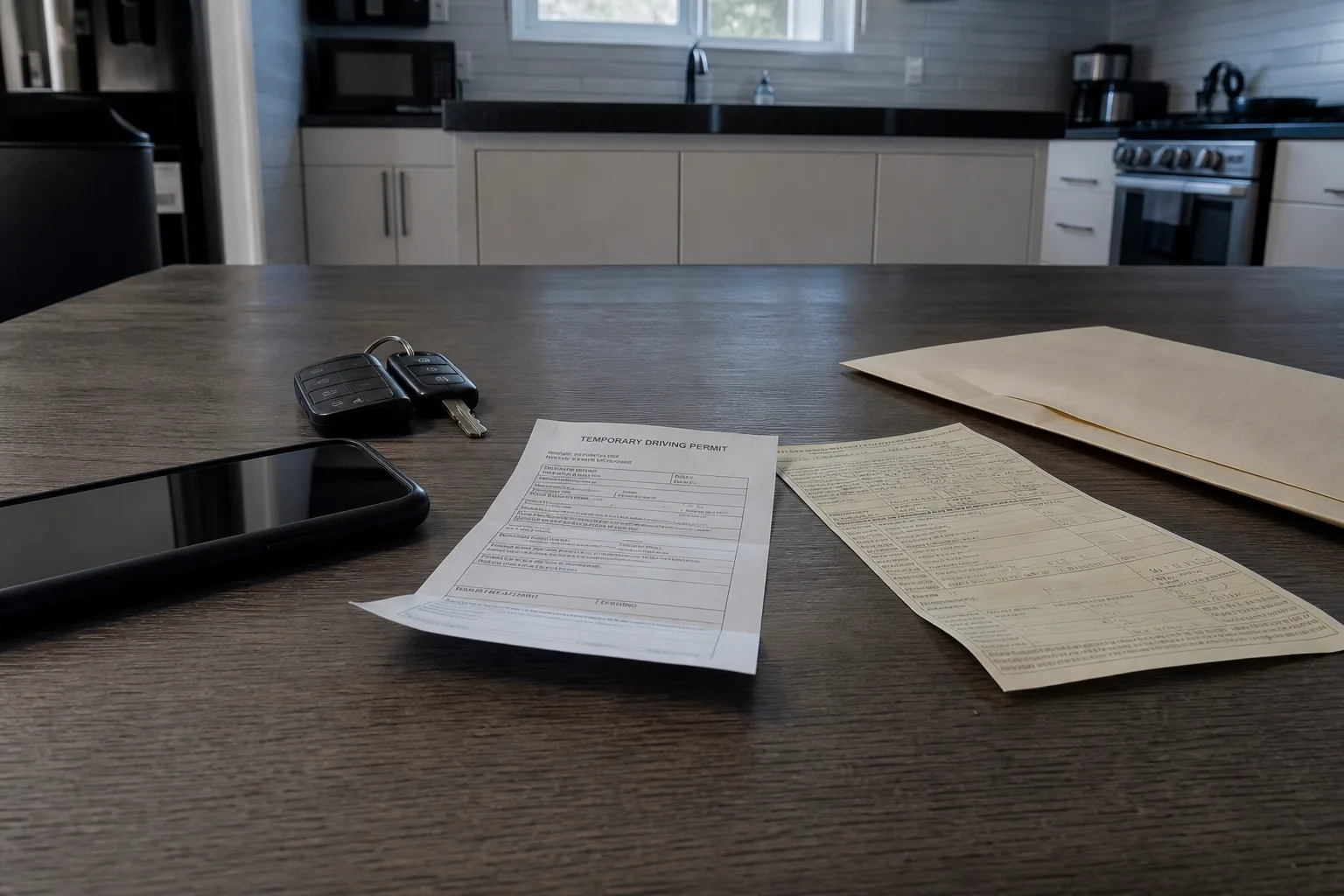
A man released at four in the morning walks out with a folded sheet of paper where his license used to be. The plastic card is in an envelope at the precinct. The paper is a temporary permit, and printed somewhere on it, usually in the same size type as everything else, is a sentence explaining that he has a limited number of days to request an administrative hearing about his driving privilege. He puts it in a jacket pocket. On Tuesday he sits down with an attorney, and the first question is not what happened at the roadside. It is whether that sheet still has days left on it.
Two separate proceedings, and only one of them is the court case
Most people arrive at a first consultation assuming there is a single case with a single judge. There are almost always two. The criminal charge moves through the court on the prosecutor's timetable, with arraignment dates that get continued and discovery that arrives in pieces. Running alongside it, on a much shorter clock, is an administrative action against the license itself, run by the state motor vehicle or licensing agency. That agency does not wait for the criminal case, does not care much what the prosecutor thinks, and in many states will suspend by default if nobody asks it not to. The party holding that decision is an agency clerk, not a judge.
The practical consequence is that the deadline governing the first week after an arrest is set by an executive branch agency, and the person addressed by that deadline is the driver, not the attorney, who has not been retained yet. That is the mismatch worth naming. Everyone talks to the defendant about court. The clock that runs out fastest belongs to a different building entirely. The National Highway Traffic Safety Administration oversees federal impaired-driving programs and standards, but the licensing consequence is administered state by state, which is why the answer changes when you cross a line on a map.
Where the rules actually diverge
The windows are short and they are not uniform. Some states measure the request period from the date of arrest, others from the date the notice was served, and a few from the date a chemical test result comes back, which can be weeks later for a blood draw. Some require a written request on a specific form, some accept a phone call, some charge a filing fee that must accompany the request or the request is void. In Washington, where the hearing request goes to the Department of Licensing and carries a fee, dui defense lawyers generally want to see the arrest paperwork before they discuss anything else, because the fee and the deadline are unforgiving in a way the criminal calendar is not.
County practice adds a second layer. Whether a first offense is charged in district court or municipal court, whether the jurisdiction runs a diversion or deferred prosecution track, whether the local prosecutor's office has a standing policy on breath test refusals: these vary between neighboring courthouses in the same state. An attorney who appears in that courthouse weekly knows the answer without research. An attorney two counties over may be guessing. That is a fair thing to ask about directly in the first ten minutes, and a good one will tell you plainly which courtrooms they work in.
The folder that makes one paid hour do the work of three
Bring the temporary permit itself, not a description of it, because the issue date and the notice language on the reverse are what set the deadline. Bring the citation or the charging paper, any bail or release paperwork, and the property receipt if one was issued. Photograph everything with your phone before you leave the house, front and back, so that a lost original does not become a lost case. Write down, that same week, the sequence of the evening in plain order: where you were, what time you left, what you were asked to do, what you were told about the test and whether you took one.
Add the practical facts about your life that shape strategy, because they are decisions in disguise. Whether you hold a commercial driver's license, whether your job requires driving, whether you have professional licensing or immigration status that a conviction touches, whether you have a prior from another state, and how far back it goes. Bring your insurance declarations page and any prior driving record you can pull from the licensing agency's online portal. None of this is glamorous. All of it changes what an attorney recommends, and none of it can be assumed.
What to settle before you leave the room
By the end of a first meeting you should be able to state, in your own words, the date the hearing request is due and who is responsible for filing it, the fee structure and whether the administrative matter is inside or outside it, the next court date, and what you are expected to do before that date. Ask what a flat fee covers if the case goes to trial, since many quotes cover pretrial work only. Ask who will actually appear, which in a multi-attorney office is not always the person across the table. Get the answers in writing before the retainer is signed.
The person who decides how useful that first hour is turns out to be the client, before the meeting starts, with a folder and a photograph of a piece of paper. Everything after that is easier to steer.