Legal Affairs
Arrested Over a Holiday Weekend? The Clock That Runs While the Courthouse Is Closed
A Seattle DUI arrest on the Saturday of a holiday weekend, reconstructed backwards, shows which deadline expires first and what to carry into the first attorney meeting.
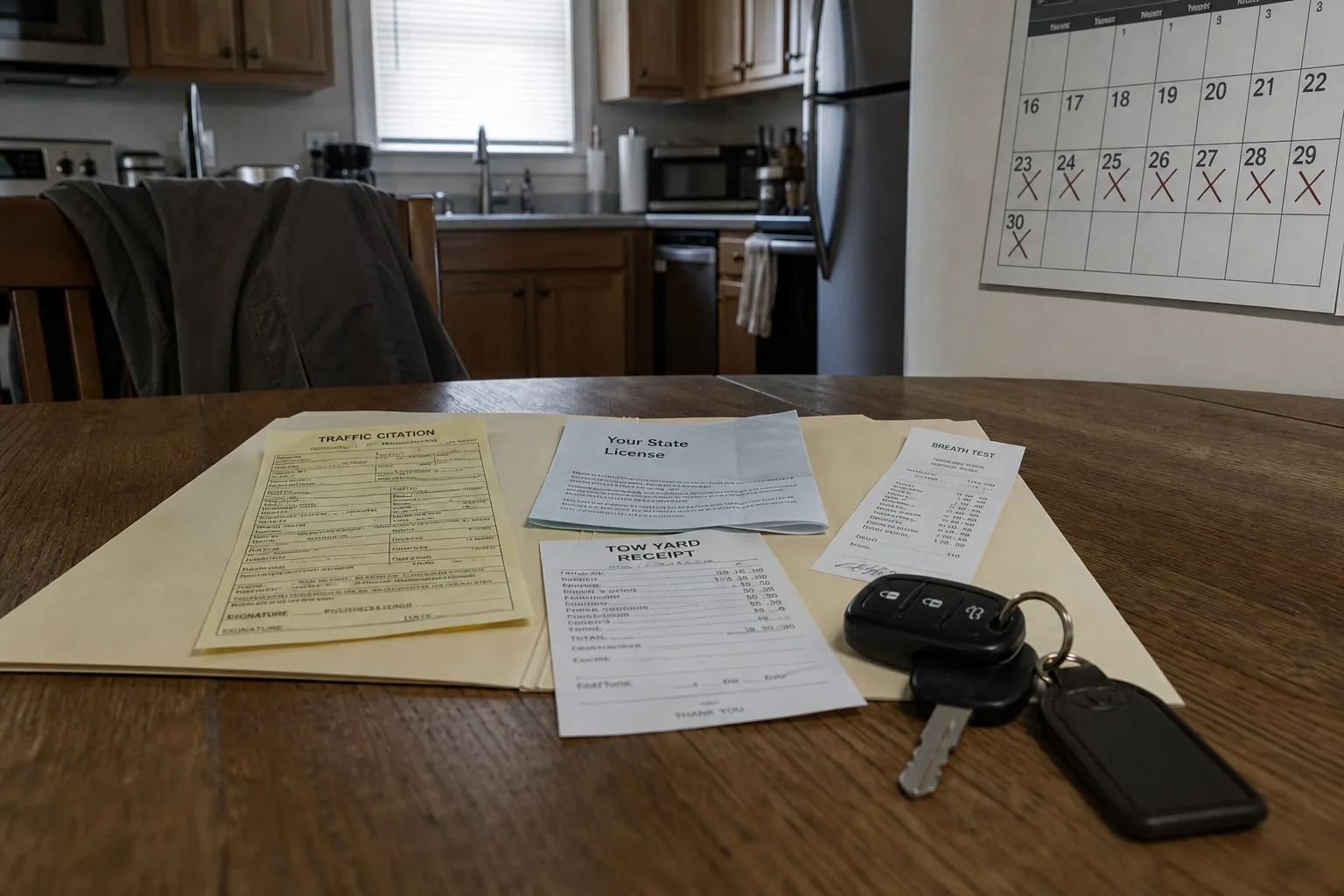
The arrest happened at 11:40 on the Saturday of Thanksgiving weekend, on Aurora Avenue North, and by the time the driver was released the following morning she had a paper bag of belongings, a citation with an arraignment date in mid-December, a tow receipt from a lot in Ballard, and a folded form the officer had handed her at the precinct that she did not read until Wednesday. Nothing about that sequence is unusual. What made it expensive was the gap between the release and the first conversation with a lawyer, seventeen days, most of them holiday days, during which the only deadline that had already started running quietly expired.
Two cases open at once, and only one of them sends reminders
A DUI arrest in Washington starts two separate proceedings that never merge. The criminal case belongs to the court named on the citation, and it announces itself: an arraignment date, a prosecutor, a docket. The administrative case belongs to the state Department of Licensing, and it does the opposite, because the burden to open it sits entirely with the driver. The form handed over at the precinct is the notice, and the window to request a hearing is measured in days rather than weeks, printed on the page itself. No one calls to confirm you received it. The holiday closure of every counter in the county changes nothing about when the count ends.
Working backwards from her outcome, the license suspension was not caused by the breath reading or by any decision a lawyer made later. It was caused by three days of assuming that the December court date was the first real thing on the calendar. She spent Sunday evening searching for a dui attorneyin seattle wa and left voicemails at four offices, all of which were closed until the following Monday, and then she stopped calling because it felt like nothing could move until someone picked up. Something could have moved. The hearing request is a form, and a driver can file it without counsel.
What the season actually changes
Late November through New Year is when the National Highway Traffic Safety Administration, which oversees federal impaired-driving enforcement campaigns, coordinates the season's emphasis patrols with state and local agencies, and Seattle participates. The practical consequence for a defendant is not that arrests are treated differently. It is that the intake side of the system slows while the deadline side does not. Public defender screening runs on shortened hours, private offices carry skeleton coverage between the holidays, impound lots accrue storage fees daily, and the tow yard closes early. Every one of those is survivable if the paperwork is gathered in the first seventy-two hours rather than after the first return call.
The protections that exist before you hire anyone
Several rules operate in a driver's favor from the roadside forward, and most of them leave a documentary trace worth preserving. In Washington, a person in custody has the right to contact an attorney before deciding whether to submit to a breath test, and the officer is required to provide a reasonable opportunity to do so, which is why the timing entries on the arrest report matter. The implied consent warnings must be given, and their content is prescribed. A driver who submits to the state's breath test also has the right to seek an independent test at their own expense, a right that is only useful within hours. Fee agreements are governed by the state's rules of professional conduct, and contingency arrangements are not permitted in criminal defense, so any quoted number should arrive in writing.
The folder that makes the first hour productive
She arrived at her first consultation with a citation and a memory. The reconstruction is straightforward: everything else existed on the night of the arrest and became harder to obtain with each passing week. The folder that would have changed the meeting contains the citation and arraignment notice, the licensing notice with its printed deadline, the temporary permit if one was issued, the breath test printout or a note that blood was drawn instead, the booking and release paperwork with its time stamps, the tow and impound receipts, and the vehicle's insurance declarations page. To that, add a written account of the evening drafted within the first week: where you were, what you consumed and when, who was with you, what you ate, what the stop looked like, and what was said.
Add the personal facts that shape strategy rather than guilt. A commercial license, a professional license with a reporting requirement, an immigration status, a job that requires driving, a prescription that interacts with breath testing, a prior in any state within the last several years. A competent defense attorney will ask about each of these, and answers given from memory in the chair are worth less than documents brought in the bag. Bar tabs and rideshare receipts carry timestamps. Text messages from that evening establish sequence. None of this is preparation for trial. It is preparation for a first meeting that produces a plan instead of a homework assignment.
What she recovered, and how
The criminal case went reasonably. Her attorney obtained the video, found a genuine question about the observation period before the breath test, and negotiated from there. The license suspension, though, ran its course, because the administrative window had closed while the offices were dark, and she drove to work under a restricted arrangement with an interlock device installed. She has said since that the single act that would have changed it took under ten minutes and required no lawyer at all: reading the form in the paper bag on Sunday morning and mailing the request that day.
The season compresses everything except the deadlines. Anyone released on a holiday weekend has one task before the offices reopen, which is to read every piece of paper they were handed and note any date printed on it, and one task after, which is to walk in with the file already built.